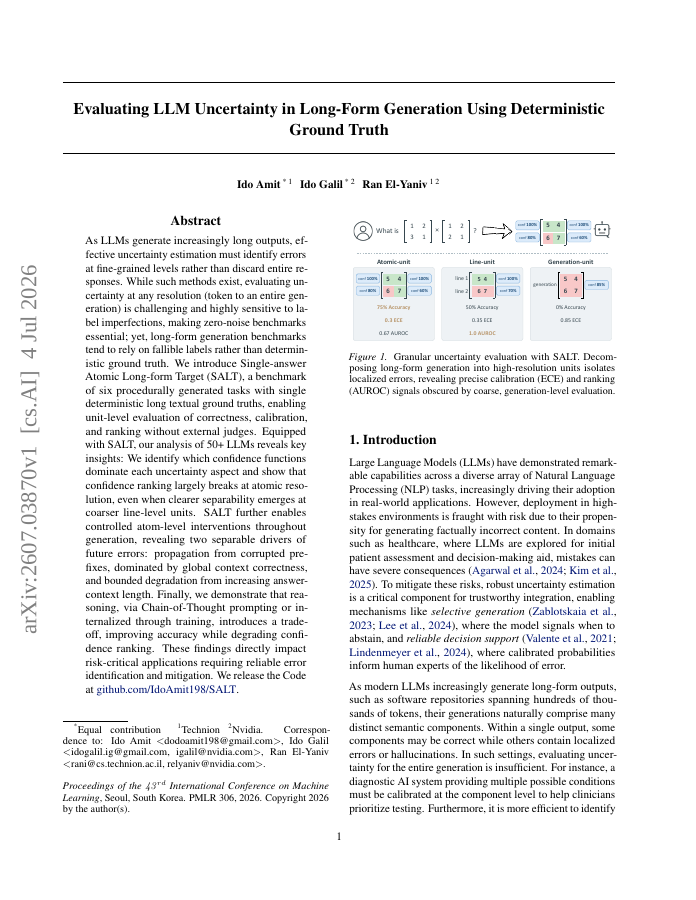
As LLMs generate increasingly long outputs, effective uncertainty estimation must identify errors at fine-grained levels rather than discard entire responses. While such methods exist, evaluating uncertainty at any resolution (token to an entire generation) is challenging and highly sensitive to label imperfections, making zero-noise benchmarks essential; yet, long-form generation benchmarks tend to rely on fallible labels rather than deterministic ground truth. We introduce Single-answer Atomic Long-form Target (SALT), a benchmark of six procedurally generated tasks with single deterministic long textual ground truths, enabling unit-level evaluation of correctness, calibration, and ranking without external judges. Equipped with SALT, our analysis of 50+ LLMs reveals key insights: We identify which confidence functions dominate each uncertainty aspect and show that confidence ranking largely breaks at atomic resolution, even when clearer separability emerges at coarser line-level units. SALT further enables controlled atom-level interventions throughout generation, revealing two separable drivers of future errors: propagation from corrupted prefixes, dominated by global context correctness, and bounded degradation from increasing answer-context length. Finally, we demonstrate that reasoning, via Chain-of-Thought prompting or internalized through training, introduces a trade-off, improving accuracy while degrading confidence ranking. These findings directly impact risk-critical applications requiring reliable error identification and mitigation.
Evaluating LLM Uncertainty in Long-Form Generation Using Deterministic Ground Truth
As LLMs generate increasingly long outputs, effective uncertainty estimation must identify errors at fine-grained levels rather than discard entire responses. While such methods exist, evaluating uncertainty at any resolution (token to an entire generation) is challenging and…
- Preview
- Year
- 2026
- Hosting
- Full text hostedCC-BY-4.0
Cite
Notes
Only stored in your browser.
Attribution
- Abstract & full text
- arxiv.org/abs/2607.03870CC-BY-4.0
- TL;DR
- Semantic Scholar