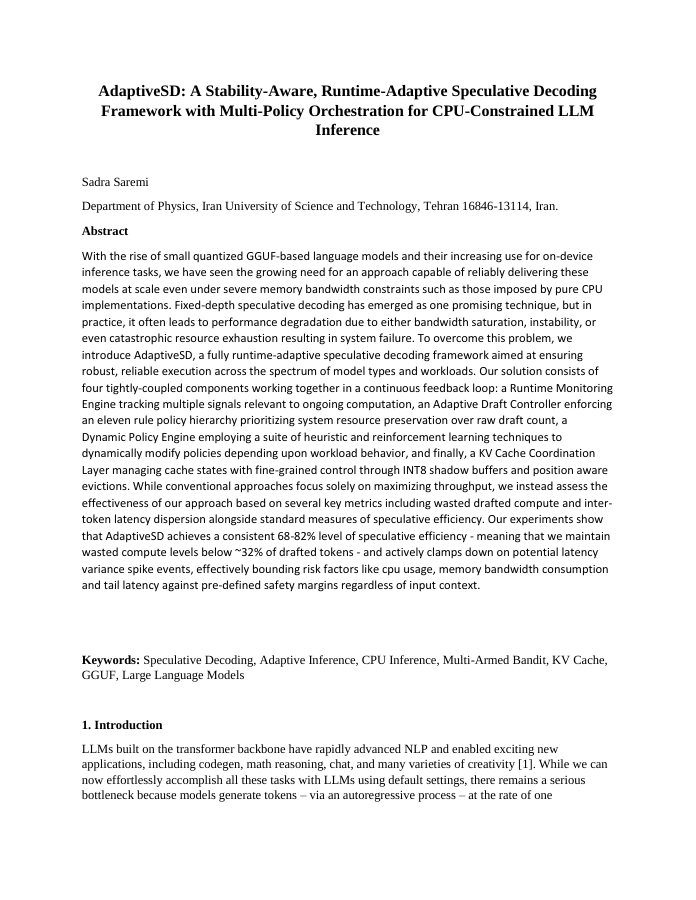
With the rise of small quantized GGUF-based language models and their increasing use for on-device inference tasks, we have seen the growing need for an approach capable of reliably delivering these models at scale even under severe memory bandwidth constraints such as those imposed by pure CPU implementations. Fixed-depth speculative decoding has emerged as one promising technique, but in practice, it often leads to performance degradation due to either bandwidth saturation, instability, or even catastrophic resource exhaustion resulting in system failure. To overcome this problem, we introduce AdaptiveSD, a fully runtime-adaptive speculative decoding framework aimed at ensuring robust, reliable execution across the spectrum of model types and workloads. Our solution consists of four tightly-coupled components working together in a continuous feedback loop: a Runtime Monitoring Engine tracking multiple signals relevant to ongoing computation, an Adaptive Draft Controller enforcing an eleven rule policy hierarchy prioritizing system resource preservation over raw draft count, a Dynamic Policy Engine employing a suite of heuristic and reinforcement learning techniques to dynamically modify policies depending upon workload behavior, and finally, a KV Cache Coordination Layer managing cache states with fine-grained control through INT8 shadow buffers and position aware evictions. While conventional approaches focus solely on maximizing throughput, we instead assess the effectiveness of our approach based on several key metrics including wasted drafted compute and inter-token latency dispersion alongside standard measures of speculative efficiency.
AdaptiveSD A Stability-Aware, Runtime-Adaptive Speculative Decoding Framework with Multi-Policy Orchestration for CPU-Constrained LLM Inference
With the rise of small quantized GGUF-based language models and their increasing use for on-device inference tasks, we have seen the growing need for an approach capable of reliably delivering these models at scale even under severe memory bandwidth constraints such as those…
- Preview
- Year
- 2026
- Hosting
- Abstract onlyARXIV-DEFAULT
Cite
Notes
Only stored in your browser.
Attribution
- Abstract & full text
- arxiv.org/abs/2607.03876ARXIV-DEFAULT
- TL;DR
- Semantic Scholar