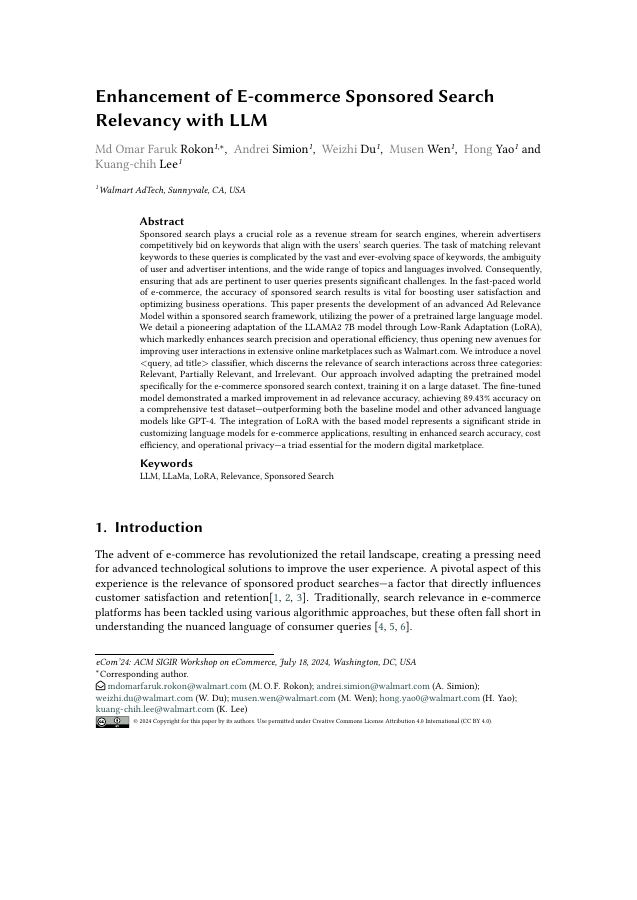
Sponsored search plays a crucial role as a revenue stream for search engines, wherein advertisers competitively bid on keywords that align with the users' search queries. The task of matching relevant keywords to these queries is complicated by the vast and ever-evolving space of keywords, the ambiguity of user and advertiser intentions, and the wide range of topics and languages involved. Consequently, ensuring that ads are pertinent to user queries presents significant challenges. In the fast-paced world of e-commerce, the accuracy of sponsored search results is vital for boosting user satisfaction and optimizing business operations. This paper presents the development of an advanced Ad Relevance Model within a sponsored search framework, utilizing the power of a pretrained large language model. We detail a pioneering adaptation of the LLAMA2 7B model through Low-Rank Adaptation (LoRA), which markedly enhances search precision and operational efficiency, thus opening new avenues for improving user interactions in extensive online marketplaces such as Walmart.com. We introduce a novel query and ad title classifier, which discerns the relevance of search interactions across three categories: Relevant, Partially Relevant, and Irrelevant. Our approach involved adapting the pretrained model specifically for the e-commerce sponsored search context, training it on a large dataset. The fine-tuned model demonstrated a marked improvement in ad relevance accuracy, achieving 89.43% accuracy on a comprehensive test dataset -- outperforming both the baseline model and other advanced language models like GPT-4. The integration of LoRA with the based model represents a significant stride in customizing language models for e-commerce applications, resulting in enhanced search accuracy, cost efficiency, and operational privacy -- a triad essential for the modern digital marketplace.
Enhancement of E-commerce Sponsored Search Relevancy with LLM
Sponsored search plays a crucial role as a revenue stream for search engines, wherein advertisers competitively bid on keywords that align with the users' search queries.
- Preview
- Year
- 2026
- Hosting
- Full text hostedCC-BY-4.0
Cite
Notes
Only stored in your browser.
Attribution
- Abstract & full text
- arxiv.org/abs/2607.03886CC-BY-4.0
- TL;DR
- Semantic Scholar