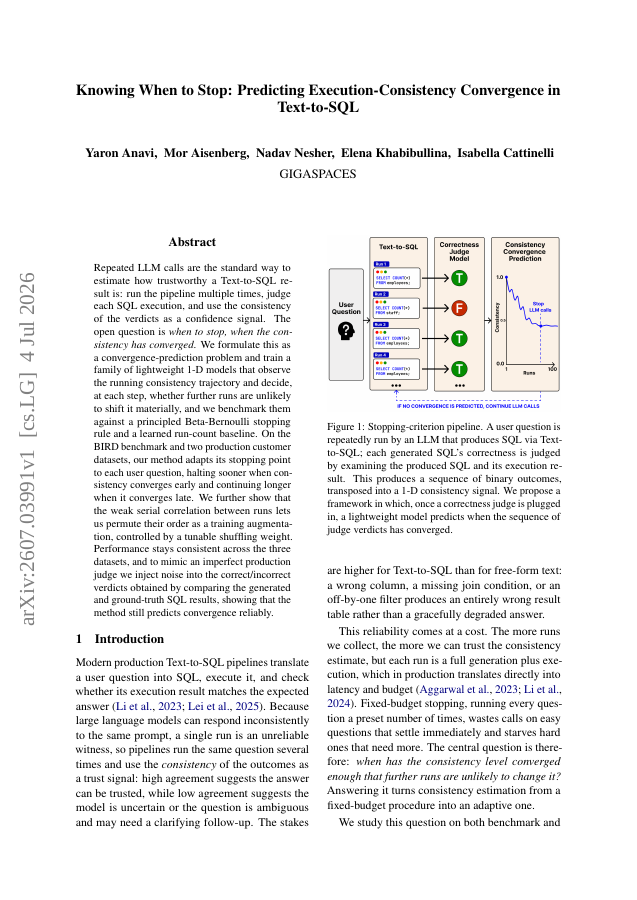
Repeated LLM calls are the standard way to estimate how trustworthy a Text-to-SQL result is: run the pipeline multiple times, judge each SQL execution, and use the consistency of the verdicts as a confidence signal. The open question is when to stop, when the consistency has converged. We formulate this as a convergence-prediction problem and train a family of lightweight 1-D models that observe the running consistency trajectory and decide, at each step, whether further runs are unlikely to shift it materially, and we benchmark them against a principled Beta-Bernoulli stopping rule and a learned run-count baseline. On the BIRD benchmark and two production customer datasets, our method adapts its stopping point to each user question, halting sooner when consistency converges early and continuing longer when it converges late. We further show that the weak serial correlation between runs lets us permute their order as a training augmentation, controlled by a tunable shuffling weight. Performance stays consistent across the three datasets, and to mimic an imperfect production judge we inject noise into the correct/incorrect verdicts obtained by comparing the generated and ground-truth SQL results, showing that the method still predicts convergence reliably.
Knowing When to Stop: Predicting Execution-Consistency Convergence in Text-to-SQL
Repeated LLM calls are the standard way to estimate how trustworthy a Text-to-SQL result is: run the pipeline multiple times, judge each SQL execution, and use the consistency of the verdicts as a confidence signal.
- Preview
- Year
- 2026
- Hosting
- Abstract onlyARXIV-DEFAULT
Cite
Notes
Only stored in your browser.
Attribution
- Abstract & full text
- arxiv.org/abs/2607.03991ARXIV-DEFAULT
- TL;DR
- Semantic Scholar