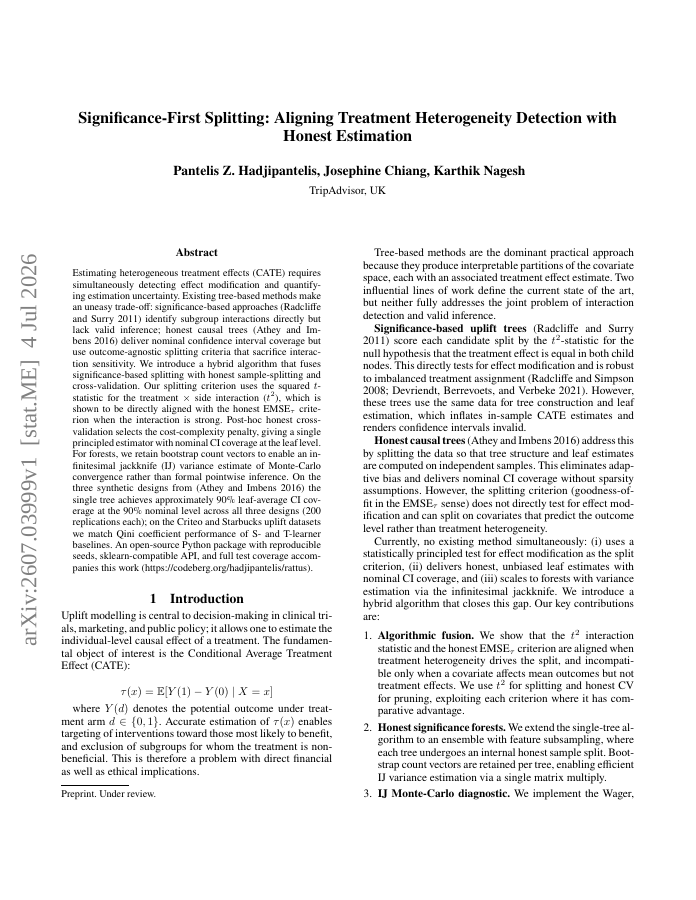
Estimating heterogeneous treatment effects (CATE) requires simultaneously detecting effect modification and quantifying estimation uncertainty. Existing tree-based methods make an uneasy trade-off: significance-based approaches (Radcliffe and Surry 2011) identify subgroup interactions directly but lack valid inference; honest causal trees (Athey and Imbens 2016) deliver nominal confidence interval coverage but use outcome-agnostic splitting criteria that sacrifice interaction sensitivity. We introduce a hybrid algorithm that fuses significance-based splitting with honest sample-splitting and cross-validation. Our splitting criterion uses the squared t-statistic for the treatment \times side interaction (t^2), which is shown to be directly aligned with the honest EMSE_τ criterion when the interaction is strong. Post-hoc honest cross-validation selects the cost-complexity penalty, giving a single principled estimator with nominal CI coverage at the leaf level. For forests, we retain bootstrap count vectors to enable an infinitesimal jackknife (IJ) variance estimate of Monte-Carlo convergence rather than formal pointwise inference. On the three synthetic designs from (Athey and Imbens 2016) the single tree achieves approximately 90% leaf-average CI coverage at the 90% nominal level across all three designs (200 replications each); on the Criteo and Starbucks uplift datasets we match Qini coefficient performance of S- and T-learner baselines. An open-source Python package with reproducible seeds, sklearn-compatible API, and full test coverage accompanies this work (https://codeberg.org/hadjipantelis/rattus).
Significance-First Splitting: Aligning Treatment Heterogeneity Detection with Honest Estimation
Estimating heterogeneous treatment effects (CATE) requires simultaneously detecting effect modification and quantifying estimation uncertainty. Existing tree-based methods make an uneasy trade-off: significance-based approaches (Radcliffe and Surry 2011) identify subgroup…
- Preview
- Year
- 2026
- Hosting
- Full text hostedCC-BY-4.0
Cite
Notes
Only stored in your browser.
Attribution
- Abstract & full text
- arxiv.org/abs/2607.03999CC-BY-4.0
- TL;DR
- Semantic Scholar