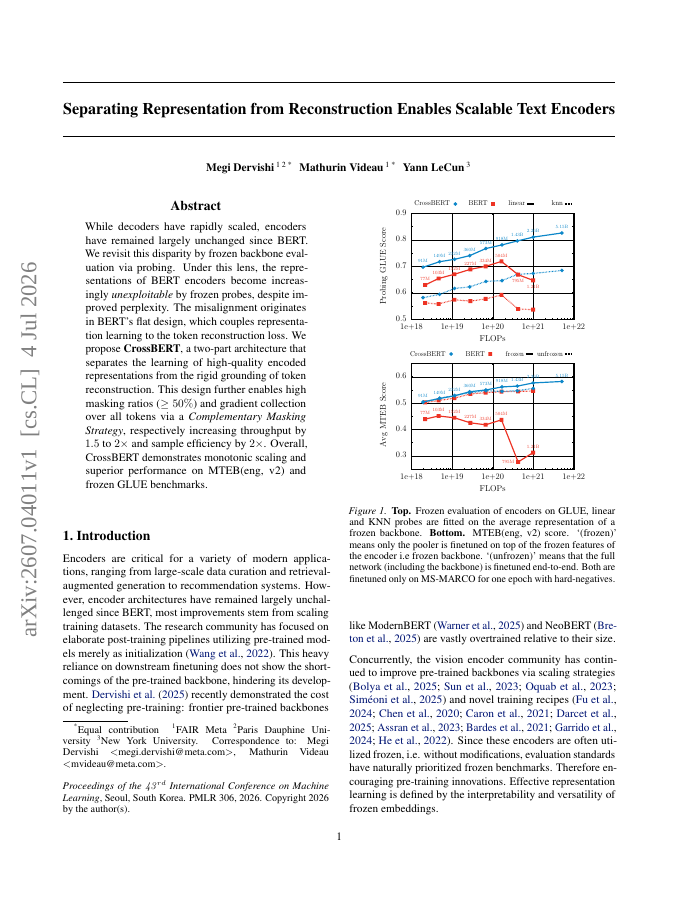
While decoders have rapidly scaled, encoders have remained largely unchanged since BERT. We revisit this disparity by frozen backbone evaluation via probing. Under this lens, the representations of BERT encoders become increasingly unexploitable by frozen probes, despite improved perplexity. The misalignment originates in BERT's flat design, which couples representation learning to the token reconstruction loss. We propose CrossBERT, a two-part architecture that separates the learning of high-quality encoded representations from the rigid grounding of token reconstruction. This design further enables high masking ratios (\ge 50%) and gradient collection over all tokens via a Complementary Masking Strategy, respectively increasing throughput by 1.5 to 2\times and sample efficiency by 2\times. Overall, CrossBERT demonstrates monotonic scaling and superior performance on MTEB(eng, v2) and frozen GLUE benchmarks.
Separating Representation from Reconstruction Enables Scalable Text Encoders
While decoders have rapidly scaled, encoders have remained largely unchanged since BERT. We revisit this disparity by frozen backbone evaluation via probing. Under this lens, the representations of BERT encoders become increasingly $\textit{unexploitable}$ by frozen probes,…
- Preview
- Year
- 2026
- Hosting
- Full text hostedCC-BY-4.0
Cite
Notes
Only stored in your browser.
Attribution
- Abstract & full text
- arxiv.org/abs/2607.04011CC-BY-4.0
- TL;DR
- Semantic Scholar