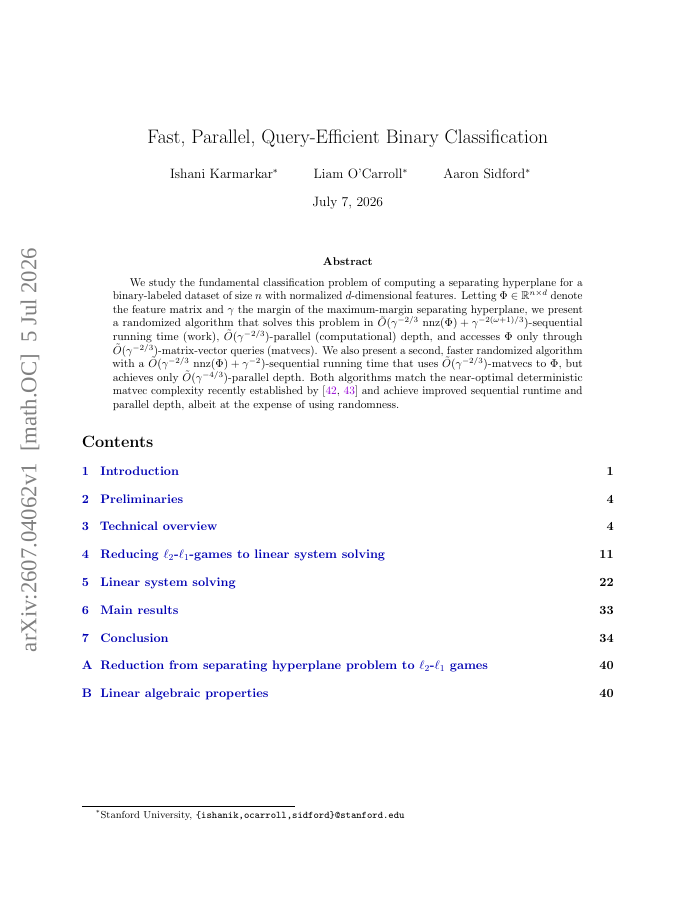
We study the fundamental classification problem of computing a separating hyperplane for a binary-labeled dataset of size n with normalized d-dimensional features. Letting Φ\in \mathbb{R}^{n \times d} denote the feature matrix and γ the margin of the maximum-margin separating hyperplane, we present a randomized algorithm that solves this problem in \tilde{O}(γ^{-2/3}, \operatorname{nnz}(Φ) + γ^{-2(ω+1)/3})-sequential running time (work), \tilde{O}(γ^{-2/3})-parallel (computational) depth, and accesses Φ only through \tilde{O}(γ^{-2/3})-matrix-vector queries (matvecs). We also present a second, faster randomized algorithm with a \tilde{O}(γ^{-2/3}, \operatorname{nnz}(Φ) + γ^{-2})-sequential running time that uses \tilde{O}(γ^{-2/3})-matvecs to Φ, but achieves only \tilde{O}(γ^{-4/3})-parallel depth. Both algorithms match the near-optimal deterministic matvec complexity recently established by Kornowski and Shamir [2025], Karmarkar et al. [2026] and achieve improved sequential runtime and parallel depth, albeit at the expense of using randomness.
Fast, Parallel, Query-Efficient Binary Classification
We study the fundamental classification problem of computing a separating hyperplane for a binary-labeled dataset of size $n$ with normalized $d$-dimensional features. Letting $Φ\in \mathbb{R}^{n \times d}$ denote the feature matrix and $γ$ the margin of the maximum-margin…
- Preview
- Year
- 2026
- Hosting
- Abstract onlyARXIV-DEFAULT
Cite
Notes
Only stored in your browser.
Attribution
- Abstract & full text
- arxiv.org/abs/2607.04062ARXIV-DEFAULT
- TL;DR
- Semantic Scholar