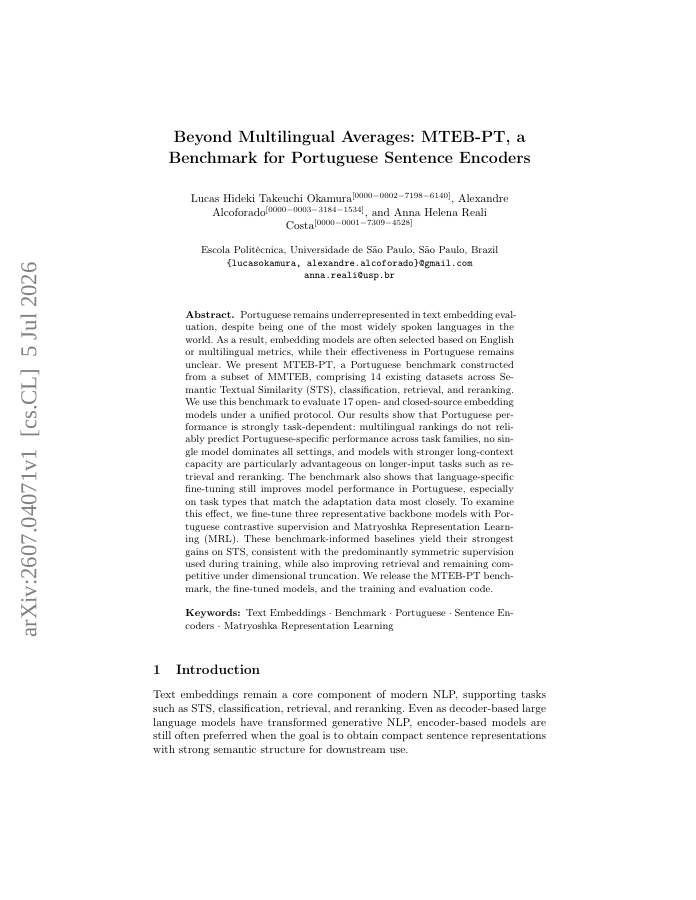
Portuguese remains underrepresented in text embedding evaluation, despite being one of the most widely spoken languages in the world. As a result, embedding models are often selected based on English or multilingual metrics, while their effectiveness in Portuguese remains unclear. We present MTEB-PT, a Portuguese benchmark constructed from a subset of MMTEB, comprising 14 existing datasets across Semantic Textual Similarity (STS), classification, retrieval, and reranking. We use this benchmark to evaluate 17 open- and closed-source embedding models under a unified protocol. Our results show that Portuguese performance is strongly task-dependent: multilingual rankings do not reliably predict Portuguese-specific performance across task families, no single model dominates all settings, and models with stronger long-context capacity are particularly advantageous on longer-input tasks such as retrieval and reranking. The benchmark also shows that language-specific fine-tuning still improves model performance in Portuguese, especially on task types that match the adaptation data most closely. To examine this effect, we fine-tune three representative backbone models with Portuguese contrastive supervision and Matryoshka Representation Learning (MRL). These benchmark-informed baselines yield their strongest gains on STS, consistent with the predominantly symmetric supervision used during training, while also improving retrieval and remaining competitive under dimensional truncation. We release the MTEB-PT benchmark, the fine-tuned models, and the training and evaluation code.
Beyond Multilingual Averages: MTEB-PT, a Benchmark for Portuguese Sentence Encoders
Portuguese remains underrepresented in text embedding evaluation, despite being one of the most widely spoken languages in the world. As a result, embedding models are often selected based on English or multilingual metrics, while their effectiveness in Portuguese remains…
- Preview
- Year
- 2026
- Hosting
- Full text hostedCC-BY-4.0
Cite
Notes
Only stored in your browser.
Attribution
- Abstract & full text
- arxiv.org/abs/2607.04071CC-BY-4.0
- TL;DR
- Semantic Scholar