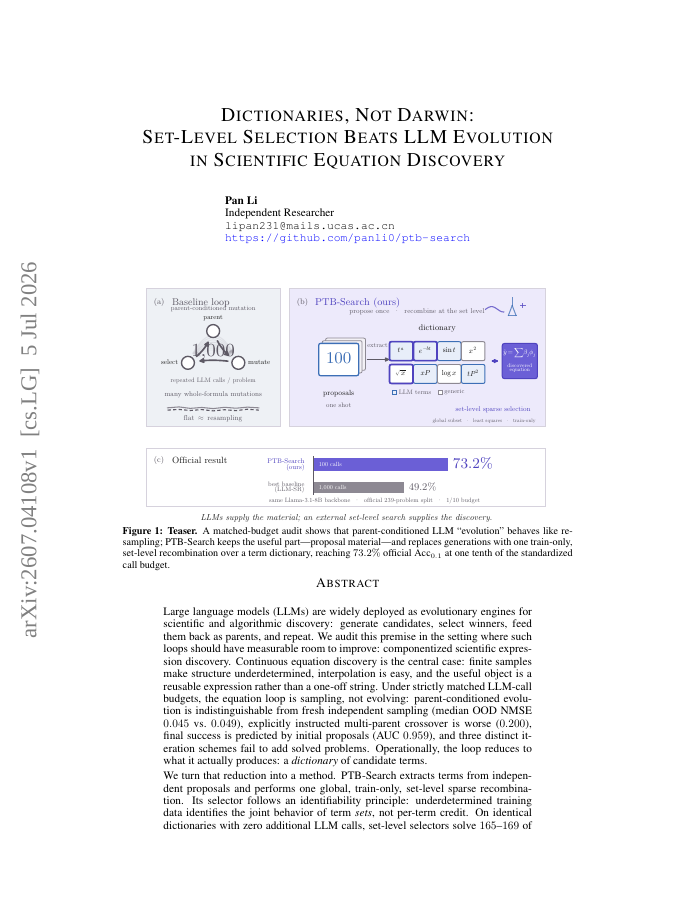
Large language models are increasingly used as evolutionary engines for scientific discovery: generate candidates, select winners, feed them back as parents, and repeat. We audit whether this loop actually compounds discovery in scientific equation discovery, a setting where finite samples make structure underdetermined and interpolation easy. Under matched LLM-call budgets, parent-conditioned evolution is indistinguishable from fresh independent sampling: median OOD NMSE is 0.045 vs. 0.049, instructed multi-parent crossover is worse, final success is predicted by initial proposal quality, and multiple iteration schemes fail to add solved problems. Operationally, the loop reduces to what it produces: a dictionary of candidate terms. We turn that diagnosis into PTB-Search, a one-generation method for componentized scientific discovery. PTB-Search samples independent LLM proposals once, extracts reusable terms into a per-problem dictionary, and performs train-only set-level sparse selection with least-squares coefficients. Its central principle is that underdetermined data identifies the joint behavior of term sets, not reliable per-term credit. On identical dictionaries and zero additional LLM calls, set-level selectors solve 165--169 of 717 cells, while single-term reductions solve only 74--78. On the official 239-problem LLM-SRBench split, PTB-Search reaches 73.2% Acc0.1 with Llama-3.1-8B and 77.0% with a single-seed DeepSeek-V4 anchor, versus 49.2% for the best reported baseline, using one tenth of the standardized call budget. A program-domain stress test gives a scoped boundary: generation count remains unreliable, while retained external state can help in harder non-linear spaces. Across these results, LLMs are best understood as material suppliers; discovery is carried by external set-level selection over reusable components.
Dictionaries, Not Darwin: Set-Level Selection Beats LLM Evolution in Scientific Equation Discovery
Large language models are increasingly used as evolutionary engines for scientific discovery: generate candidates, select winners, feed them back as parents, and repeat.
- Preview
- Year
- 2026
- Hosting
- Abstract onlyARXIV-DEFAULT
Cite
Notes
Only stored in your browser.
Attribution
- Abstract & full text
- arxiv.org/abs/2607.04108ARXIV-DEFAULT
- TL;DR
- Semantic Scholar