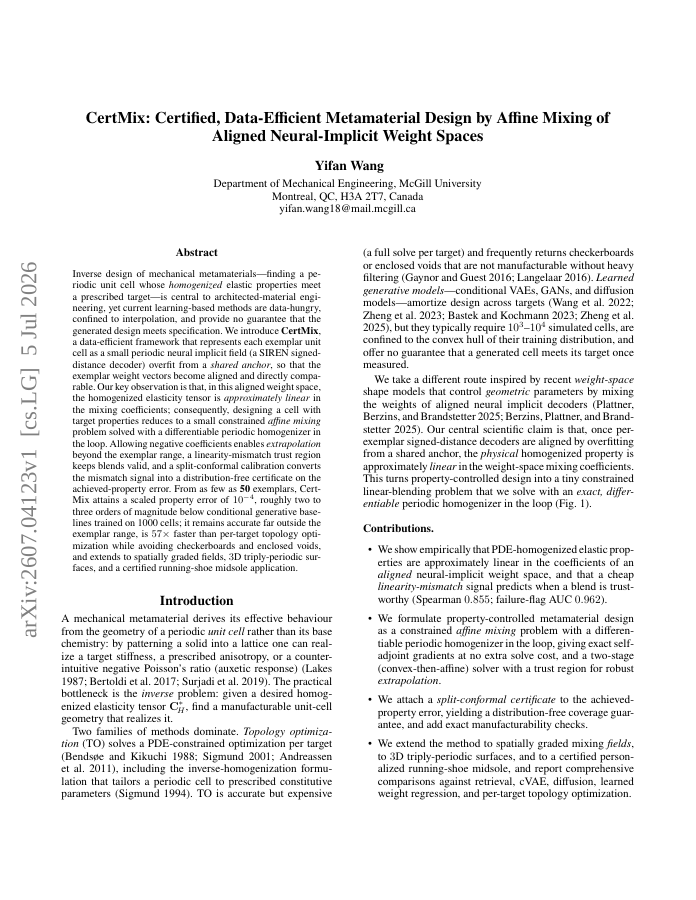
Inverse design of mechanical metamaterials seeks a periodic unit cell whose homogenized elastic properties meet a prescribed target, but current learning-based methods are data-hungry, mostly interpolative, and provide no guarantee that the generated design satisfies the specification. We introduce CertMix, a data-efficient framework that represents each exemplar unit cell as a small periodic neural implicit field, specifically a SIREN signed-distance decoder overfit from a shared anchor, so that exemplar weight vectors become aligned and directly comparable. The key observation is that, in this aligned weight space, the homogenized elasticity tensor is approximately linear in the mixing coefficients. Targeted design therefore reduces to a small constrained affine-mixing problem solved with a differentiable periodic homogenizer in the loop. Negative coefficients enable extrapolation beyond the exemplar range, a linearity-mismatch trust region keeps blends valid, and split-conformal calibration converts the mismatch signal into a distribution-free certificate on achieved-property error. From as few as 50 exemplars, CertMix attains a scaled property error of 10^{-4}, roughly two to three orders of magnitude below conditional generative baselines trained on 1000 cells. It remains accurate far outside the exemplar range, is 57\times faster than per-target topology optimization while avoiding checkerboards and enclosed voids, and extends to spatially graded fields, 3D triply periodic surfaces, and a certified running-shoe midsole application.
CertMix: Certified, Data-Efficient Metamaterial Design by Affine Mixing of Aligned Neural-Implicit Weight Spaces
Inverse design of mechanical metamaterials seeks a periodic unit cell whose homogenized elastic properties meet a prescribed target, but current learning-based methods are data-hungry, mostly interpolative, and provide no guarantee that the generated design satisfies the…
- Preview
- Year
- 2026
- Hosting
- Abstract onlyARXIV-DEFAULT
Cite
Notes
Only stored in your browser.
Attribution
- Abstract & full text
- arxiv.org/abs/2607.04123ARXIV-DEFAULT
- TL;DR
- Semantic Scholar