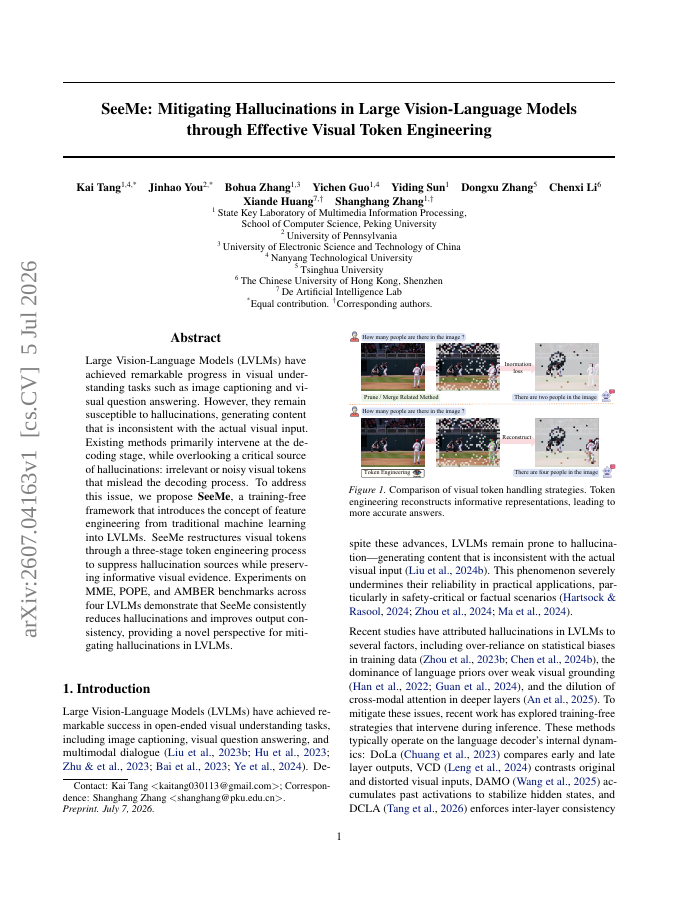
Large Vision-Language Models (LVLMs) have achieved remarkable progress in visual understanding tasks such as image captioning and visual question answering. However, they remain susceptible to hallucinations, generating content that is inconsistent with the actual visual input. Existing methods primarily intervene at the decoding stage, while overlooking a critical source of hallucinations: irrelevant or noisy visual tokens that mislead the decoding process. To address this issue, we propose SeeMe, a training-free framework that introduces the concept of feature engineering from traditional machine learning into LVLMs. SeeMe restructures visual tokens through a three-stage token engineering process to suppress hallucination sources while preserving informative visual evidence. Experiments on MME, POPE, and AMBER benchmarks across four LVLMs demonstrate that SeeMe consistently reduces hallucinations and improves output consistency, providing a novel perspective for mitigating hallucinations in LVLMs.
SeeMe: Mitigating Hallucinations in Large Vision-Language Models through Effective Visual Token Engineering
Large Vision-Language Models (LVLMs) have achieved remarkable progress in visual understanding tasks such as image captioning and visual question answering. However, they remain susceptible to hallucinations, generating content that is inconsistent with the actual visual input.
- Preview
- Year
- 2026
- Hosting
- Abstract onlyARXIV-DEFAULT
Cite
Notes
Only stored in your browser.
Attribution
- Abstract & full text
- arxiv.org/abs/2607.04163ARXIV-DEFAULT
- TL;DR
- Semantic Scholar