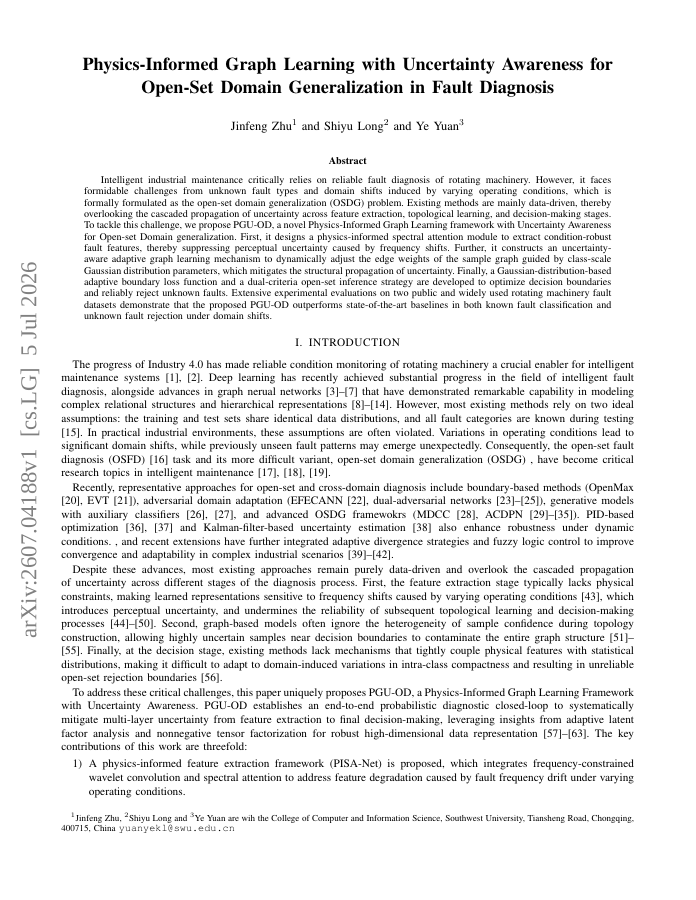
Intelligent industrial maintenance critically relies on reliable fault diagnosis of rotating machinery. However, it faces formidable challenges from unknown fault types and domain shifts induced by varying operating conditions, which is formally formulated as the open-set domain generalization (OSDG) problem. Existing methods are mainly data-driven, thereby overlooking the cascaded propagation of uncertainty across feature extraction, topological learning, and decision-making stages.To tackle this challenge, we propose PGU-OD, a novel Physics-Informed Graph Learning framework with Uncertainty Awareness for Open-set Domain generalization. First, it designs a physics-informed spectral attention module to extract condition-robust fault features, thereby suppressing perceptual uncertainty caused by frequency shifts. Further, it constructs an uncertainty aware adaptive graph learning mechanism to dynamically adjust the edge weights of the sample graph guided by class-scale Gaussian distribution parameters, which mitigates the structural propagation of uncertainty. Finally, a Gaussian-distribution-based adaptive boundary loss function and a dual-criteria open-set inference strategy are developed to optimize decision boundaries and reliably reject unknown faults. Extensive experimental evaluations on two public and widely used rotating machinery fault datasets demonstrate that the proposed PGU-OD outperforms state-of-the-art baselines in both known fault classification and unknown fault rejection under domain shifts.
Physics-Informed Graph Learning with Uncertainty Awareness for Open-Set Domain Generalization in Fault Diagnosis
Intelligent industrial maintenance critically relies on reliable fault diagnosis of rotating machinery. However, it faces formidable challenges from unknown fault types and domain shifts induced by varying operating conditions, which is formally formulated as the open-set domain…
- Preview
- Year
- 2026
- Hosting
- Abstract onlyARXIV-DEFAULT
Cite
Notes
Only stored in your browser.
Attribution
- Abstract & full text
- arxiv.org/abs/2607.04188ARXIV-DEFAULT
- TL;DR
- Semantic Scholar