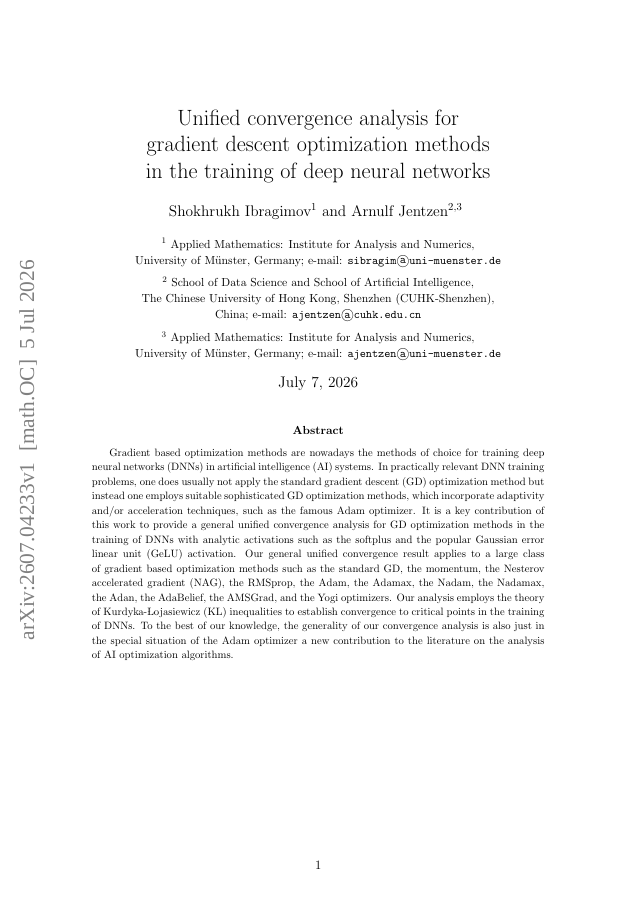
Gradient based optimization methods are nowadays the methods of choice for training deep neural networks (DNNs) in artificial intelligence (AI) systems. In practically relevant DNN training problems, one does usually not apply the standard gradient descent (GD) optimization method but instead one employs suitable sophisticated GD optimization methods, which incorporate adaptivity and/or acceleration techniques, such as the famous Adam optimizer. It is a key contribution of this work to provide a general unified convergence analysis for GD optimization methods in the training of DNNs with analytic activations such as the softplus and the popular Gaussian error linear unit (GeLU) activation. Our general unified convergence result applies to a large class of gradient based optimization methods such as the standard GD, the momentum, the Nesterov accelerated gradient (NAG), the RMSprop, the Adam, the Adamax, the Nadam, the Nadamax, the Adan, the AdaBelief, the AMSGrad, and the Yogi optimizers. Our analysis employs the theory of Kurdyka-Łojasiewicz (KL) inequalities to establish convergence to critical points in the training of DNNs. To the best of our knowledge, the generality of our convergence analysis is also just in the special situation of the Adam optimizer a new contribution to the literature on the analysis of AI optimization algorithms.
Unified convergence analysis for gradient descent optimization methods in the training of deep neural networks
Gradient based optimization methods are nowadays the methods of choice for training deep neural networks (DNNs) in artificial intelligence (AI) systems. In practically relevant DNN training problems, one does usually not apply the standard gradient descent (GD) optimization…
- Preview
- Year
- 2026
- Hosting
- Abstract onlyARXIV-DEFAULT
Cite
Notes
Only stored in your browser.
Attribution
- Abstract & full text
- arxiv.org/abs/2607.04233ARXIV-DEFAULT
- TL;DR
- Semantic Scholar