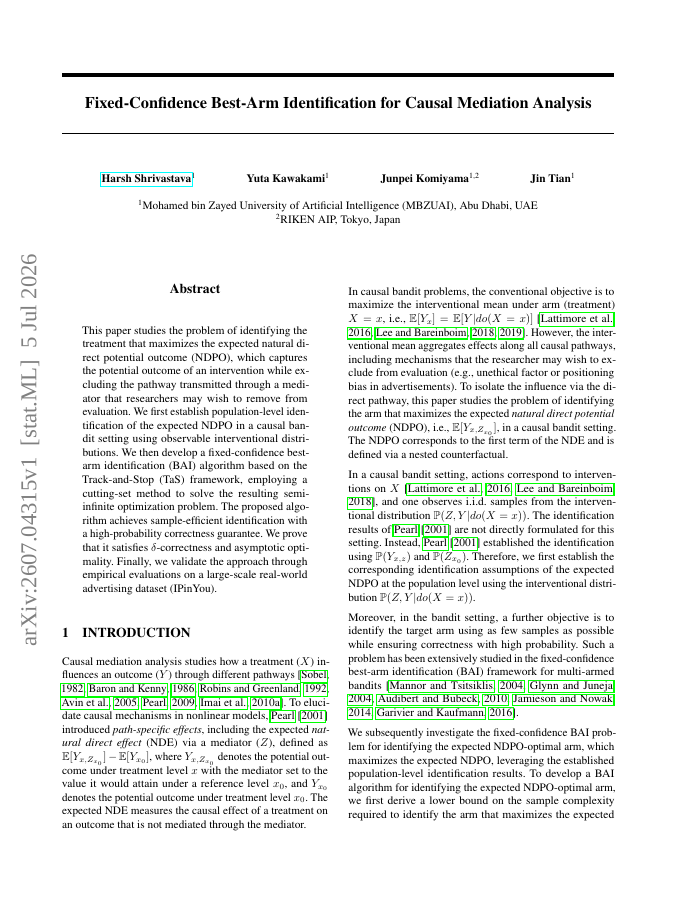
This paper studies the problem of identifying the treatment that maximizes the expected natural direct potential outcome (NDPO), which captures the potential outcome of an intervention while excluding the pathway transmitted through a mediator that researchers may wish to remove from evaluation. We first establish population-level identification of the expected NDPO in a causal bandit setting using observable interventional distributions. We then develop a fixed-confidence best-arm identification (BAI) algorithm based on the Track-and-Stop (TaS) framework, employing a cutting-set method to solve the resulting semi-infinite optimization problem. The proposed algorithm achieves sample-efficient identification with a high-probability correctness guarantee. We prove that it satisfies δ-correctness and asymptotic optimality. Finally, we validate the approach through empirical evaluations on a large-scale real-world advertising dataset (IPinYou).
Fixed-Confidence Best-Arm Identification for Causal Mediation Analysis
This paper studies the problem of identifying the treatment that maximizes the expected natural direct potential outcome (NDPO), which captures the potential outcome of an intervention while excluding the pathway transmitted through a mediator that researchers may wish to remove…
- Preview
- Year
- 2026
- Hosting
- Full text hostedCC-BY-4.0
Cite
Notes
Only stored in your browser.
Attribution
- Abstract & full text
- arxiv.org/abs/2607.04315CC-BY-4.0
- TL;DR
- Semantic Scholar