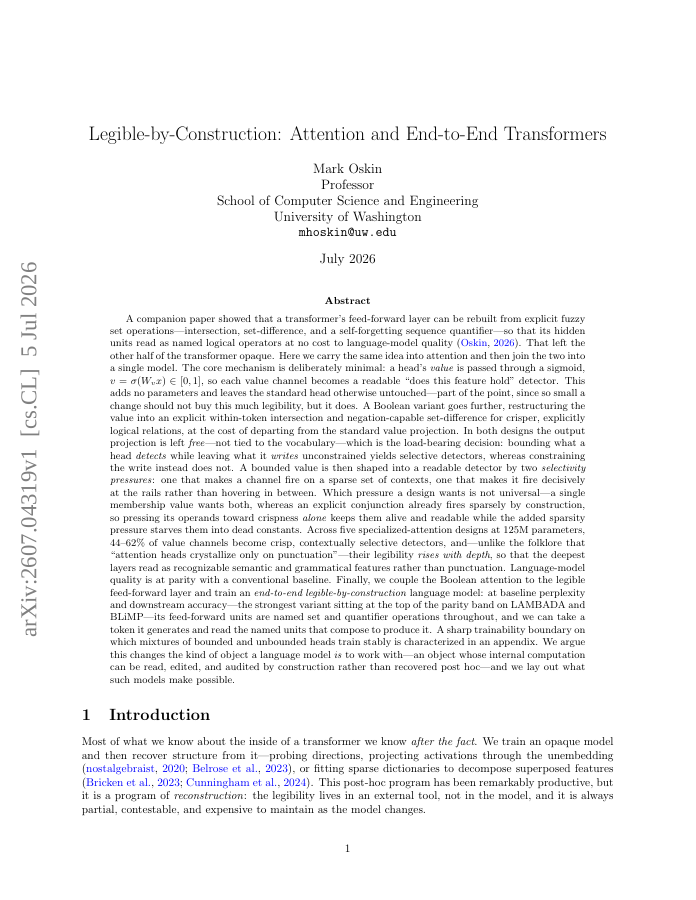
A companion paper showed that a transformer's feed-forward layer can be rebuilt from explicit fuzzy set operations - intersection, set-difference, and a self-forgetting sequence quantifier - so its hidden units read as named logical operators at no cost to language-model quality. That left the other half of the transformer opaque. Here we carry the same idea into attention and join the two into one model. The mechanism is minimal: a head's value is passed through a sigmoid, so each value channel becomes a readable detector of whether a feature holds at a token. This adds no parameters and leaves the standard head otherwise untouched. A Boolean variant goes further, restructuring the value into an explicit within-token intersection and negation-capable set-difference. In both designs the output projection is left free, not tied to the vocabulary, which is the load-bearing decision: bounding what a head detects while leaving what it writes unconstrained yields selective detectors, whereas constraining the write does not. A bounded value is shaped into a readable detector by two selectivity pressures - one for sparse firing, one for decisive firing at the rails - and which a design wants is not universal. Across five specialized-attention designs at 125M parameters, 44 to 62 percent of value channels become crisp, contextually selective detectors, and their legibility rises with depth rather than crystallizing only on punctuation. Language-model quality is at parity with a conventional baseline. Finally, we couple the Boolean attention to the legible feed-forward layer and train an end-to-end legible-by-construction language model at benchmark parity: its feed-forward units are named set and quantifier operations throughout, and we can take a token it generates and read the named units that compose to produce it.
Legible-by-Construction: Attention and End-to-End Transformers
A companion paper showed that a transformer's feed-forward layer can be rebuilt from explicit fuzzy set operations - intersection, set-difference, and a self-forgetting sequence quantifier - so its hidden units read as named logical operators at no cost to language-model…
- Preview
- Year
- 2026
- Hosting
- Full text hostedCC-BY-4.0
Cite
Notes
Only stored in your browser.
Attribution
- Abstract & full text
- arxiv.org/abs/2607.04319CC-BY-4.0
- TL;DR
- Semantic Scholar