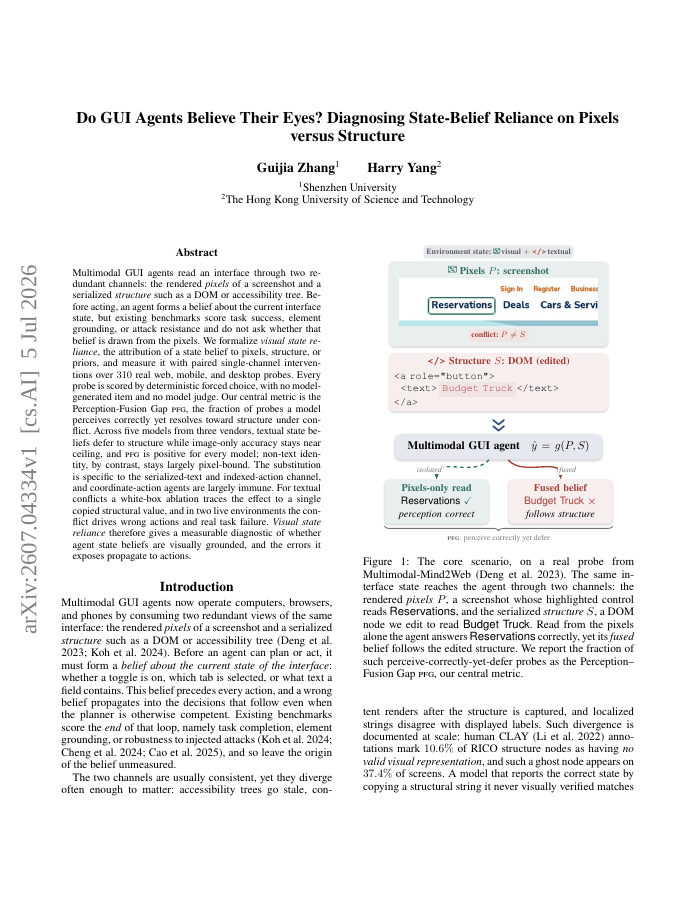
Multimodal GUI agents read an interface through two redundant channels: the rendered pixels of a screenshot and a serialized structure such as a DOM or accessibility tree. Before acting, an agent forms a belief about the current interface state, but existing benchmarks score task success, element grounding, or attack resistance and do not ask whether that belief is drawn from the pixels. We formalize visual state reliance, the attribution of a state belief to pixels, structure, or priors, and measure it with paired single-channel interventions over 310 real web, mobile, and desktop probes. Every probe is scored by deterministic forced choice, with no model-generated item and no model judge. Our central metric is the Perception-Fusion Gap, the fraction of probes a model perceives correctly yet resolves toward structure under conflict. Across five models from three vendors, textual state beliefs defer to structure while image-only accuracy stays near ceiling, and Perception-Fusion Gap is positive for every model; non-text identity, by contrast, stays largely pixel-bound. The substitution is specific to the serialized-text and indexed-action channel, and coordinate-action agents are largely immune. For textual conflicts, a white-box ablation traces the effect to a single copied structural value, and in two live environments the conflict drives wrong actions and real task failure. Visual state reliance therefore gives a measurable diagnostic of whether agent state beliefs are visually grounded, and the errors it exposes propagate to actions.
Do GUI Agents Believe Their Eyes? Diagnosing State-Belief Reliance on Pixels versus Structure
Multimodal GUI agents read an interface through two redundant channels: the rendered pixels of a screenshot and a serialized structure such as a DOM or accessibility tree.
- Preview
- Year
- 2026
- Hosting
- Abstract onlyARXIV-DEFAULT
Cite
Notes
Only stored in your browser.
Attribution
- Abstract & full text
- arxiv.org/abs/2607.04334ARXIV-DEFAULT
- TL;DR
- Semantic Scholar