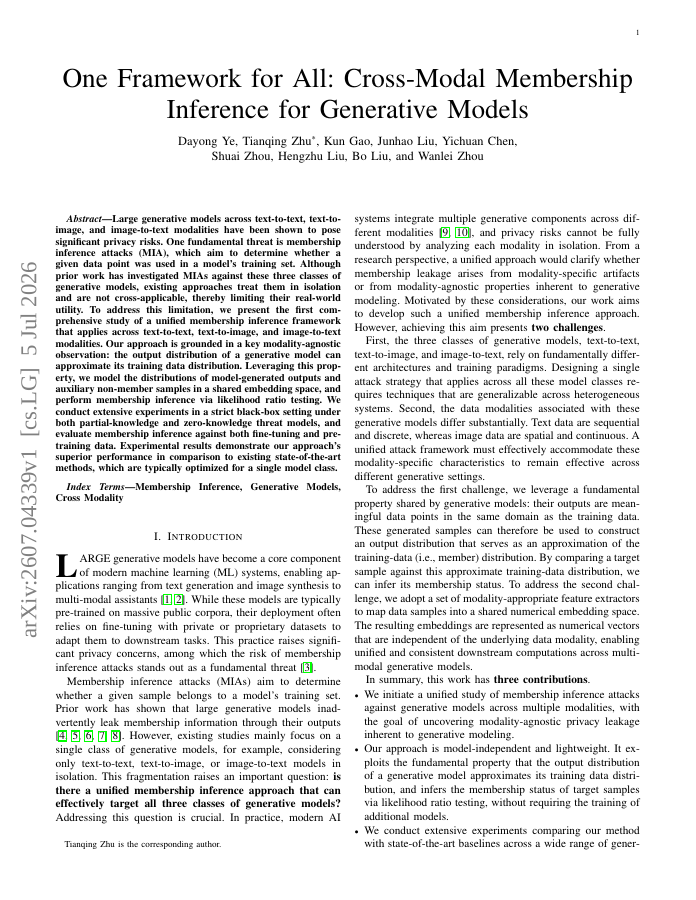
Large generative models across text-to-text, text-to-image, and image-to-text modalities have been shown to pose significant privacy risks. One fundamental threat is membership inference attacks (MIA), which aim to determine whether a given data point was used in a model's training set. Although prior work has investigated MIAs against these three classes of generative models, existing approaches treat them in isolation and are not cross-applicable, thereby limiting their real-world utility. To address this limitation, we present the first comprehensive study of a unified membership inference framework that applies across text-to-text, text-to-image, and image-to-text modalities. Our approach is grounded in a key modality-agnostic observation: the output distribution of a generative model can approximate its training data distribution. Leveraging this property, we model the distributions of model-generated outputs and auxiliary non-member samples in a shared embedding space, and perform membership inference via likelihood ratio testing. We conduct extensive experiments in a strict black-box setting under both partial-knowledge and zero-knowledge threat models, and evaluate membership inference against both fine-tuning and pre-training data. Experimental results demonstrate our approach's superior performance in comparison to existing state-of-the-art methods, which are typically optimized for a single model class.
One Framework for All: Cross-Modal Membership Inference for Generative Models
Large generative models across text-to-text, text-to-image, and image-to-text modalities have been shown to pose significant privacy risks. One fundamental threat is membership inference attacks (MIA), which aim to determine whether a given data point was used in a model's…
- Preview
- Year
- 2026
- Hosting
- Excerpt onlyCC-BY-NC-SA-4.0
Cite
Notes
Only stored in your browser.
Attribution
- Abstract & full text
- arxiv.org/abs/2607.04339CC-BY-NC-SA-4.0
- TL;DR
- Semantic Scholar