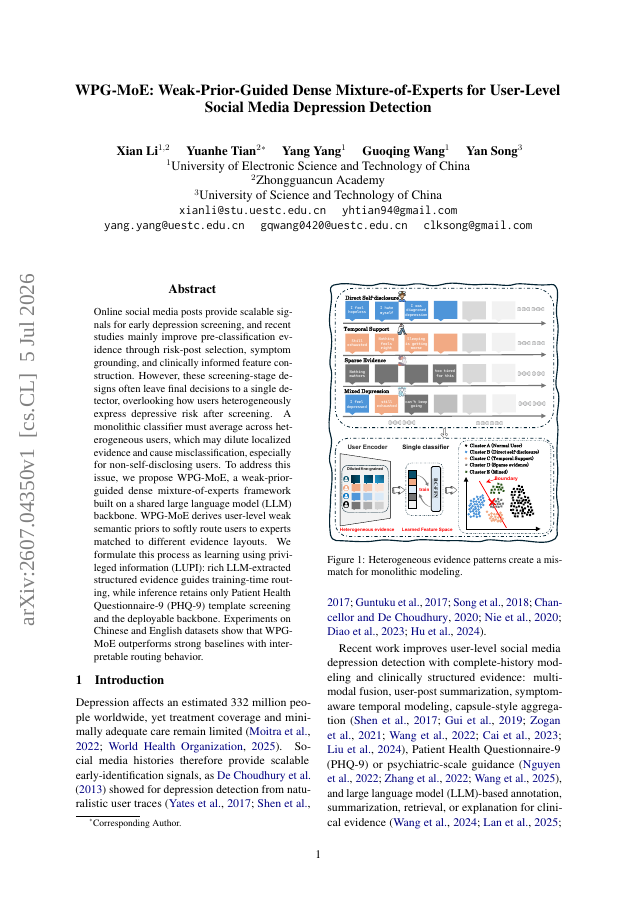
Online social media posts provide scalable signals for early depression screening, and recent studies mainly improve pre-classification evidence through risk-post selection, symptom grounding, and clinically informed feature construction. However, these screening-stage designs often leave final decisions to a single detector, overlooking how users heterogeneously express depressive risk after screening. A monolithic classifier must average across heterogeneous users, which may dilute localized evidence and cause misclassification, especially for non-self-disclosing users. To address this issue, we propose WPG-MoE, a weak-prior-guided dense mixture-of-experts framework built on a shared large language model (LLM) backbone. WPG-MoE derives user-level weak semantic priors to softly route users to experts matched to different evidence layouts. We formulate this process as learning using privileged information (LUPI): rich LLM-extracted structured evidence guides training-time routing, while inference retains only Patient Health Questionnaire-9 (PHQ-9) template screening and the deployable backbone. Experiments on Chinese and English datasets show that WPG-MoE outperforms strong baselines with interpretable routing behavior.
WPG-MoE: Weak-Prior-Guided Dense Mixture-of-Experts for User-Level Social Media Depression Detection
Online social media posts provide scalable signals for early depression screening, and recent studies mainly improve pre-classification evidence through risk-post selection, symptom grounding, and clinically informed feature construction.
- Preview
- Year
- 2026
- Hosting
- Full text hostedCC-BY-4.0
Cite
Notes
Only stored in your browser.
Attribution
- Abstract & full text
- arxiv.org/abs/2607.04350CC-BY-4.0
- TL;DR
- Semantic Scholar