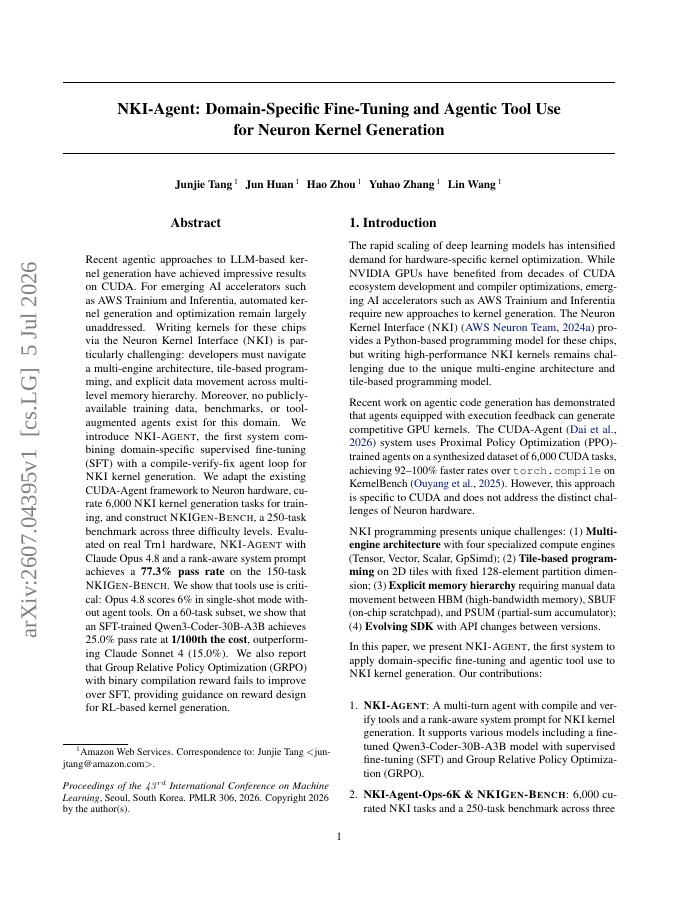
Recent agentic approaches to LLM-based kernel generation have achieved impressive results on CUDA. For emerging AI accelerators such as AWS Trainium and Inferentia, automated kernel generation and optimization remain largely unaddressed. Writing kernels for these chips via the Neuron Kernel Interface (NKI) is particularly challenging: developers must navigate a multi-engine architecture, tile-based programming, and explicit data movement across multi-level memory hierarchy. Moreover, no publicly-available training data, benchmarks, or tool-augmented agents exist for this domain. We introduce NKI-Agent, the first system combining domain-specific supervised fine-tuning (SFT) with a compile-verify-fix agent loop for NKI kernel generation. We adapt the existing CUDA-Agent framework to Neuron hardware, curate 6,000 NKI kernel generation tasks for training, and construct NKIBench, a 250-task benchmark across three difficulty levels. Evaluated on real Trn1 hardware, NKI-Agent with Claude Opus 4.8 and a rank-aware system prompt achieves a 77.3% pass rate on the 150-task NKIBench. We show that tool use is critical: Opus 4.8 scores 6% in single-shot mode without agent tools. On a 60-task subset, we show that an SFT-trained Qwen3-Coder-30B-A3B achieves 25.0% pass rate at 1/100th the cost, outperforming Claude Sonnet 4 (15.0%). We also report that Group Relative Policy Optimization (GRPO) with binary compilation reward fails to improve over SFT, providing guidance on reward design for RL-based kernel generation.
NKI-Agent: Domain-Specific Fine-Tuning and Agentic Tool Use for Neuron Kernel Generation
Recent agentic approaches to LLM-based kernel generation have achieved impressive results on CUDA. For emerging AI accelerators such as AWS Trainium and Inferentia, automated kernel generation and optimization remain largely unaddressed.
- Preview
- Year
- 2026
- Hosting
- Abstract onlyARXIV-DEFAULT
Cite
Notes
Only stored in your browser.
Attribution
- Abstract & full text
- arxiv.org/abs/2607.04395ARXIV-DEFAULT
- TL;DR
- Semantic Scholar