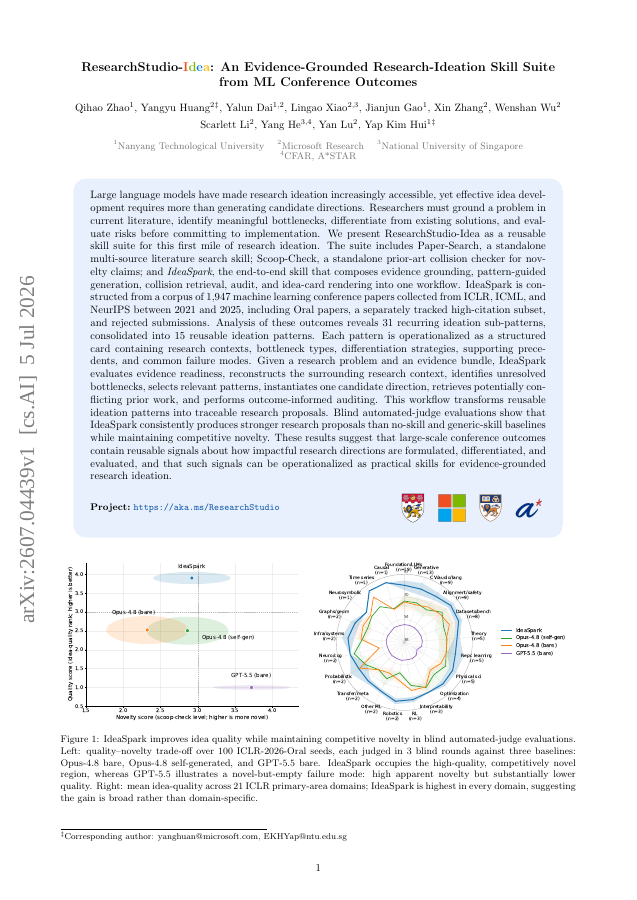
Large language models have made research ideation increasingly accessible, yet effective idea development requires more than generating candidate directions. Researchers must ground a problem in current literature, identify meaningful bottlenecks, differentiate from existing solutions, and evaluate risks before committing to implementation. We present ResearchStudio-Idea as a reusable skill suite for this first mile of research ideation. The suite includes Paper-Search, a standalone multi-source literature search skill; Scoop-Check, a standalone prior-art collision checker for novelty claims; and IdeaSpark, the end-to-end skill that composes evidence grounding, pattern-guided generation, collision retrieval, audit, and idea-card rendering into one workflow. IdeaSpark is constructed from a corpus of 1,947 machine learning conference papers collected from ICLR, ICML, and NeurIPS between 2021 and 2025, including Oral papers, a separately tracked high-citation subset, and rejected submissions. Analysis of these outcomes reveals 31 recurring ideation sub-patterns, consolidated into 15 reusable ideation patterns. Each pattern is operationalized as a structured card containing research contexts, bottleneck types, differentiation strategies, supporting precedents, and common failure modes. Given a research problem and an evidence bundle, IdeaSpark evaluates evidence readiness, reconstructs the surrounding research context, identifies unresolved bottlenecks, selects relevant patterns, instantiates one candidate direction, retrieves potentially conflicting prior work, and performs outcome-informed auditing. This workflow transforms reusable ideation patterns into traceable research proposals. Blind automated-judge evaluations show that IdeaSpark consistently produces stronger research proposals than no-skill and generic-skill baselines while maintaining competitive novelty.
ResearchStudio-Idea: An Evidence-Grounded Research-Ideation Skill Suite from ML Conference Outcomes
Large language models have made research ideation increasingly accessible, yet effective idea development requires more than generating candidate directions. Researchers must ground a problem in current literature, identify meaningful bottlenecks, differentiate from existing…
- Preview
- Year
- 2026
- Hosting
- Full text hostedCC-BY-4.0
Cite
Notes
Only stored in your browser.
Attribution
- Abstract & full text
- arxiv.org/abs/2607.04439CC-BY-4.0
- TL;DR
- Semantic Scholar