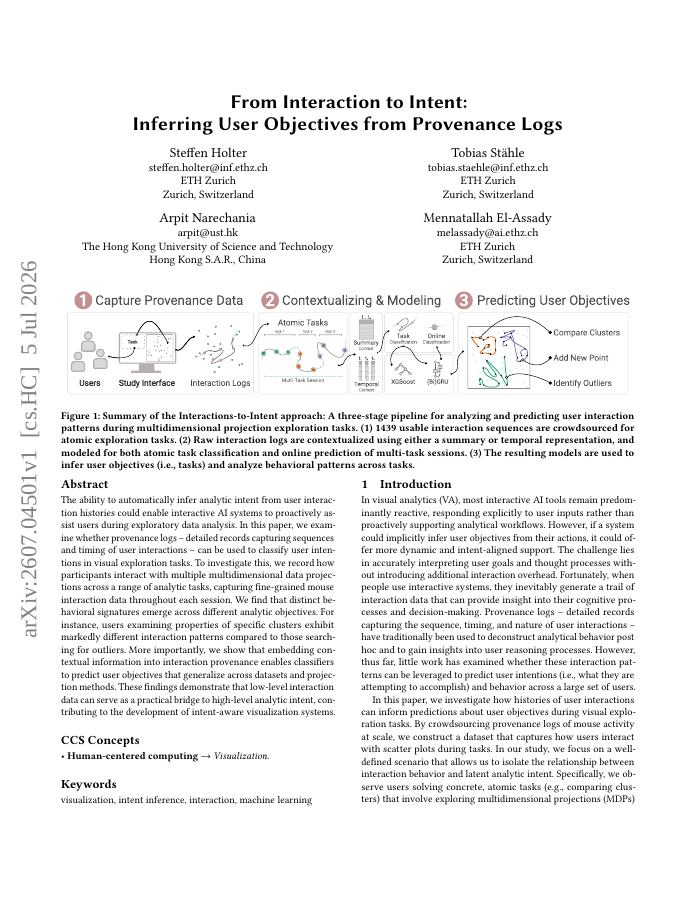
The ability to automatically infer analytic intent from user interaction histories could enable interactive AI systems to proactively assist users during exploratory data analysis. In this paper, we examine whether provenance logs -- detailed records capturing sequences and timing of user interactions -- can be used to classify user intentions in visual exploration tasks. To investigate this, we record how participants interact with multiple multidimensional data projections across a range of analytic tasks, capturing fine-grained mouse interaction data throughout each session. We find that distinct behavioral signatures emerge across different analytic objectives. For instance, users examining properties of specific clusters exhibit markedly different interaction patterns compared to those searching for outliers. More importantly, we show that embedding contextual information into interaction provenance enables classifiers to predict user objectives that generalize across datasets and projection methods. These findings demonstrate that low-level interaction data can serve as a practical bridge to high-level analytic intent, contributing to the development of intent-aware visualization systems.
From Interaction to Intent: Inferring User Objectives from Provenance Logs
The ability to automatically infer analytic intent from user interaction histories could enable interactive AI systems to proactively assist users during exploratory data analysis.
- Preview
- Year
- 2026
- Hosting
- Excerpt onlyCC-BY-NC-SA-4.0
Cite
Notes
Only stored in your browser.
Attribution
- Abstract & full text
- arxiv.org/abs/2607.04501CC-BY-NC-SA-4.0
- TL;DR
- Semantic Scholar