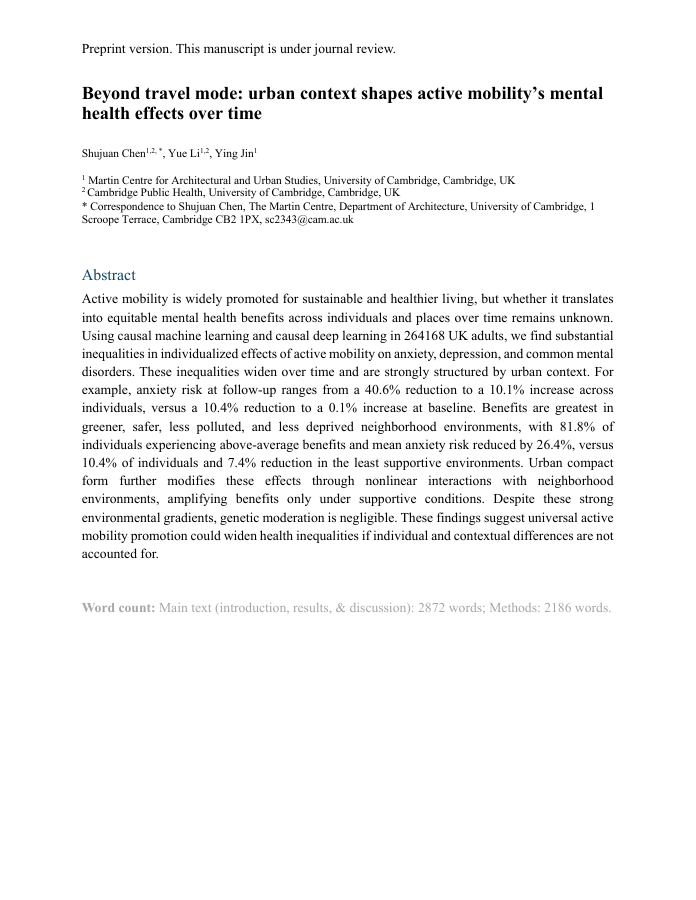
Active mobility is widely promoted for sustainable and healthier living, but whether it translates into equitable mental health benefits across individuals and places over time remains unknown. Using causal machine learning and causal deep learning in 264168 UK adults, we find substantial inequalities in individualized effects of active mobility on anxiety, depression, and common mental disorders. These inequalities widen over time and are strongly structured by urban context. For example, anxiety risk at follow-up ranges from a 40.6% reduction to a 10.1% increase across individuals, versus a 10.4% reduction to a 0.1% increase at baseline. Benefits are greatest in greener, safer, less polluted, and less deprived neighborhood environments, with 81.8% of individuals experiencing above-average benefits and mean anxiety risk reduced by 26.4%, versus 10.4% of individuals and 7.4% reduction in the least supportive environments. Urban compact form further modifies these effects through nonlinear interactions with neighborhood environments, amplifying benefits only under supportive conditions. Despite these strong environmental gradients, genetic moderation is negligible. These findings suggest universal active mobility promotion could widen health inequalities if individual and contextual differences are not accounted for.
Beyond travel mode: urban context shapes active mobility's mental health effects over time
Active mobility is widely promoted for sustainable and healthier living, but whether it translates into equitable mental health benefits across individuals and places over time remains unknown.
- Preview
- Year
- 2026
- Hosting
- Abstract onlyARXIV-DEFAULT
Cite
Notes
Only stored in your browser.
Attribution
- Abstract & full text
- arxiv.org/abs/2607.04520ARXIV-DEFAULT
- TL;DR
- Semantic Scholar