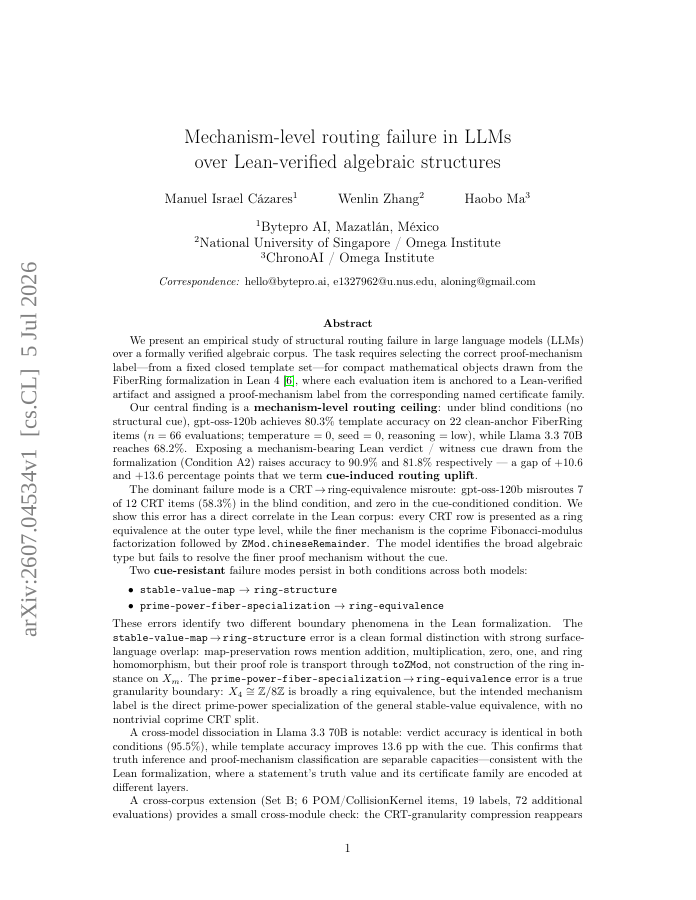
We present an empirical study of structural routing failure in large language models (LLMs) over a formally verified algebraic corpus. The task requires selecting the correct proof-mechanism label from a fixed closed template set for compact mathematical objects drawn from the FiberRing formalization in Lean 4, where each item is anchored to a Lean-verified artifact and assigned a label from the corresponding certificate family. Our central finding is a mechanism-level routing ceiling: under blind conditions, gpt-oss-120b achieves 80.3% template accuracy on 22 FiberRing items (n=66; temperature=0, seed=0), while Llama 3.3 70B reaches 68.2%. Exposing a mechanism-bearing Lean verdict/witness cue (Condition A2) raises accuracy to 90.9% and 81.8% -- gaps of +10.6 and +13.6 pp termed cue-induced routing uplift. The dominant failure is a CRT-to-ring-equivalence misroute: gpt-oss-120b misroutes 7 of 12 CRT items (58.3%) blind, zero under A2. A cross-model dissociation in Llama is notable: verdict accuracy is identical in both conditions (95.5%), while template accuracy improves 13.6 pp -- confirming that truth inference and proof-mechanism classification are separable capacities. A cross-corpus extension (Set B; 6 POM/CollisionKernel items, 72 evaluations) provides a small cross-module check: CRT-granularity compression reappears with different labels, and an inverse cross-model dissociation emerges. These findings extend the router hypothesis (Cazares 2026) to formal algebraic structures. The full pipeline, manifest, and results are at https://github.com/bytepro-ai/fiber-routing-eval.
Mechanism-level routing failure in LLMs over Lean-verified algebraic structures
We present an empirical study of structural routing failure in large language models (LLMs) over a formally verified algebraic corpus. The task requires selecting the correct proof-mechanism label from a fixed closed template set for compact mathematical objects drawn from the…
- Preview
- Year
- 2026
- Hosting
- Full text hostedCC-BY-4.0
Cite
Notes
Only stored in your browser.
Attribution
- Abstract & full text
- arxiv.org/abs/2607.04534CC-BY-4.0
- TL;DR
- Semantic Scholar