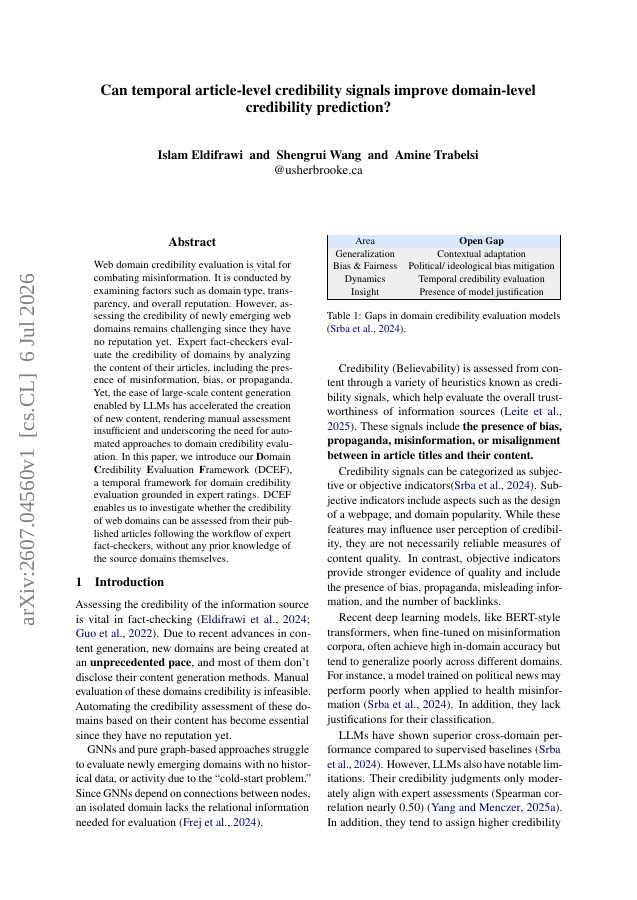
Web domain credibility evaluation is vital for combating misinformation. It is conducted by examining factors such as domain type, transparency, and overall reputation. However, assessing the credibility of newly emerging web domains remains challenging since they have no reputation yet. Expert fact-checkers evaluate the credibility of domains by analyzing the content of their articles, including the presence of misinformation, bias, or propaganda. Yet, the ease of large-scale content generation enabled by LLMs has accelerated the creation of new content, rendering manual assessment insufficient and underscoring the need for automated approaches to domain credibility evaluation. In this paper, we introduce our Domain Credibility Evaluation Framework (DCEF), a temporal framework for domain credibility evaluation grounded in expert ratings. DCEF enables us to investigate whether the credibility of web domains can be assessed from their published articles following the workflow of expert fact-checkers, without any prior knowledge of the source domains themselves.
Can temporal article-level credibility signals improve domain-level credibility prediction?
Web domain credibility evaluation is vital for combating misinformation. It is conducted by examining factors such as domain type, transparency, and overall reputation. However, assessing the credibility of newly emerging web domains remains challenging since they have no…
- Preview
- Year
- 2026
- Hosting
- Full text hostedCC-BY-4.0
Cite
Notes
Only stored in your browser.
Attribution
- Abstract & full text
- arxiv.org/abs/2607.04560CC-BY-4.0
- TL;DR
- Semantic Scholar