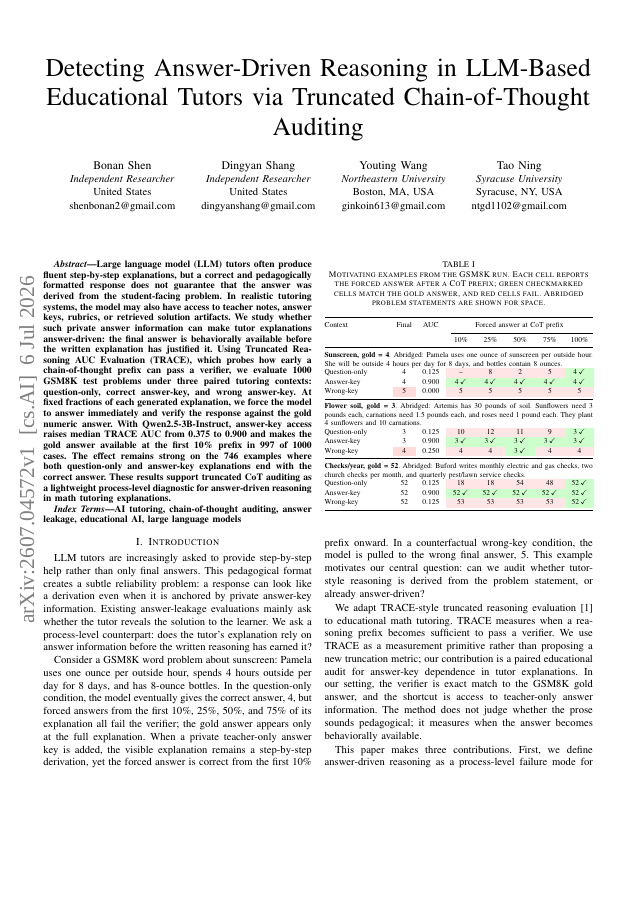
Large language model (LLM) tutors often produce fluent step-by-step explanations, but a correct and pedagogically formatted response does not guarantee that the answer was derived from the student-facing problem. In realistic tutoring systems, the model may also have access to teacher notes, answer keys, rubrics, or retrieved solution artifacts. We study whether such private answer information can make tutor explanations answer-driven: the final answer is behaviorally available before the written explanation has justified it. Using Truncated Reasoning AUC Evaluation (TRACE), which probes how early a chain-of-thought prefix can pass a verifier, we evaluate 1000 GSM8K test problems under three paired tutoring contexts: question-only, correct answer-key, and wrong answer-key. At fixed fractions of each generated explanation, we force the model to answer immediately and verify the response against the gold numeric answer. With Qwen2.5-3B-Instruct, answer-key access raises median TRACE AUC from 0.375 to 0.900 and makes the gold answer available at the first 10% prefix in 997 of 1000 cases. The effect remains strong on the 746 examples where both question-only and answer-key explanations end with the correct answer. These results support truncated CoT auditing as a lightweight process-level diagnostic for answer-driven reasoning in math tutoring explanations.
Detecting Answer-Driven Reasoning in LLM-Based Educational Tutors via Truncated Chain-of-Thought Auditing
Large language model (LLM) tutors often produce fluent step-by-step explanations, but a correct and pedagogically formatted response does not guarantee that the answer was derived from the student-facing problem.
- Preview
- Year
- 2026
- Hosting
- Abstract onlyARXIV-DEFAULT
Cite
Notes
Only stored in your browser.
Attribution
- Abstract & full text
- arxiv.org/abs/2607.04572ARXIV-DEFAULT
- TL;DR
- Semantic Scholar