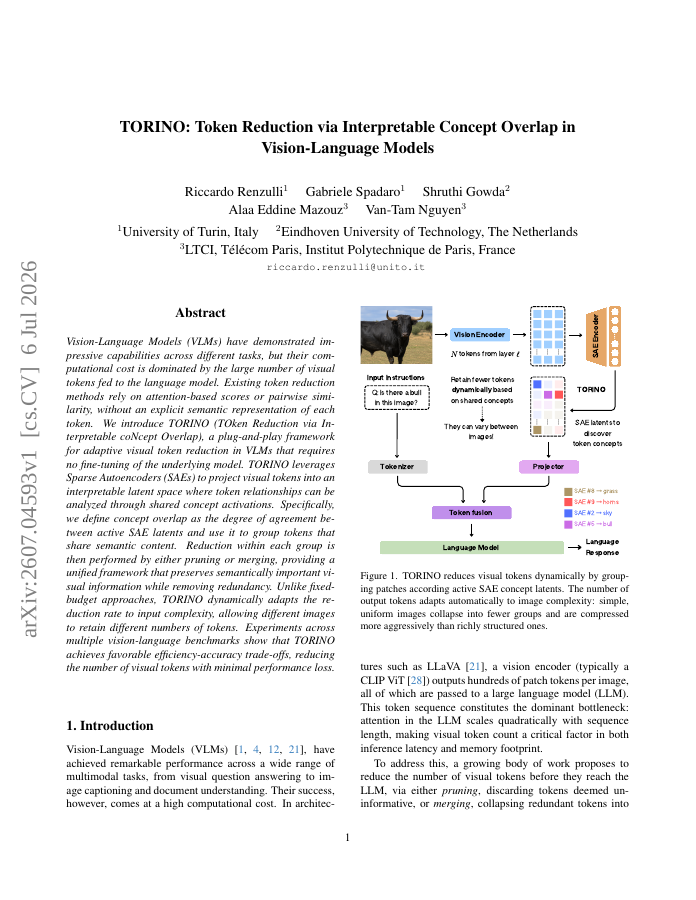
Vision-Language Models (VLMs) have demonstrated impressive capabilities across different tasks, but their computational cost is dominated by the large number of visual tokens fed to the language model. Existing token reduction methods rely on attention-based scores or pairwise similarity, without an explicit semantic representation of each token. We introduce TORINO (TOken Reduction via Interpretable coNcept Overlap), a plug-and-play framework for adaptive visual token reduction in VLMs that requires no fine-tuning of the underlying model. TORINO leverages Sparse Autoencoders (SAEs) to project visual tokens into an interpretable latent space where token relationships can be analyzed through shared concept activations. Specifically, we define concept overlap as the degree of agreement between active SAE latents and use it to group tokens that share semantic content. Reduction within each group is then performed by either pruning or merging, providing a unified framework that preserves semantically important visual information while removing redundancy. Unlike fixed-budget approaches, TORINO dynamically adapts the reduction rate to input complexity, allowing different images to retain different numbers of tokens. Experiments across multiple vision-language benchmarks show that TORINO achieves favorable efficiency-accuracy trade-offs, reducing the number of visual tokens with minimal performance loss.
TORINO: Token Reduction via Interpretable Concept Overlap in Vision-Language Models
Vision-Language Models (VLMs) have demonstrated impressive capabilities across different tasks, but their computational cost is dominated by the large number of visual tokens fed to the language model.
- Preview
- Year
- 2026
- Hosting
- Full text hostedCC-BY-4.0
Cite
Notes
Only stored in your browser.
Attribution
- Abstract & full text
- arxiv.org/abs/2607.04593CC-BY-4.0
- TL;DR
- Semantic Scholar