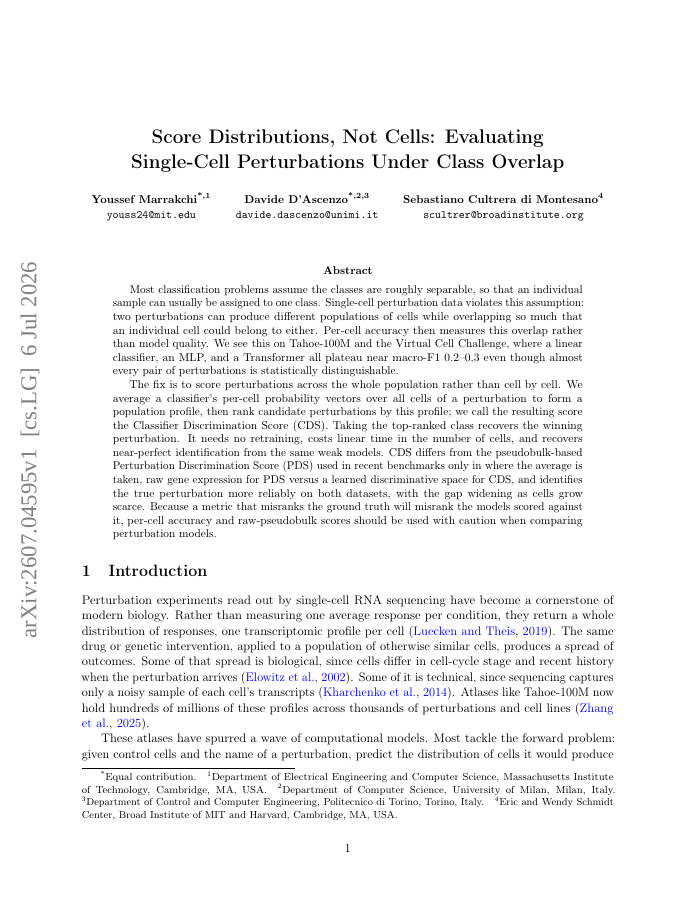
Most classification problems assume the classes are roughly separable, so that an individual sample can usually be assigned to one class. Single-cell perturbation data violates this assumption: two perturbations can produce different populations of cells while overlapping so much that an individual cell could belong to either. Per-cell accuracy then measures this overlap rather than model quality. We see this on Tahoe-100M and the Virtual Cell Challenge, where a linear classifier, an MLP, and a Transformer all plateau near macro-F1 0.2-0.3 even though almost every pair of perturbations is statistically distinguishable. The fix is to score perturbations across the whole population rather than cell by cell. We average a classifier's per-cell probability vectors over all cells of a perturbation to form a population profile, then rank candidate perturbations by this profile; we call the resulting score the Classifier Discrimination Score (CDS). Taking the top-ranked class recovers the winning perturbation. It needs no retraining, costs linear time in the number of cells, and recovers near-perfect identification from the same weak models. CDS differs from the pseudobulk-based Perturbation Discrimination Score (PDS) used in recent benchmarks only in where the average is taken, raw gene expression for PDS versus a learned discriminative space for CDS, and identifies the true perturbation more reliably on both datasets, with the gap widening as cells grow scarce. Because a metric that misranks the ground truth will misrank the models scored against it, per-cell accuracy and raw-pseudobulk scores should be used with caution when comparing perturbation models.
Score Distributions, Not Cells: Evaluating Single-Cell Perturbations Under Class Overlap
Most classification problems assume the classes are roughly separable, so that an individual sample can usually be assigned to one class. Single-cell perturbation data violates this assumption: two perturbations can produce different populations of cells while overlapping so…
- Preview
- Year
- 2026
- Hosting
- Abstract onlyARXIV-DEFAULT
Cite
Notes
Only stored in your browser.
Attribution
- Abstract & full text
- arxiv.org/abs/2607.04595ARXIV-DEFAULT
- TL;DR
- Semantic Scholar