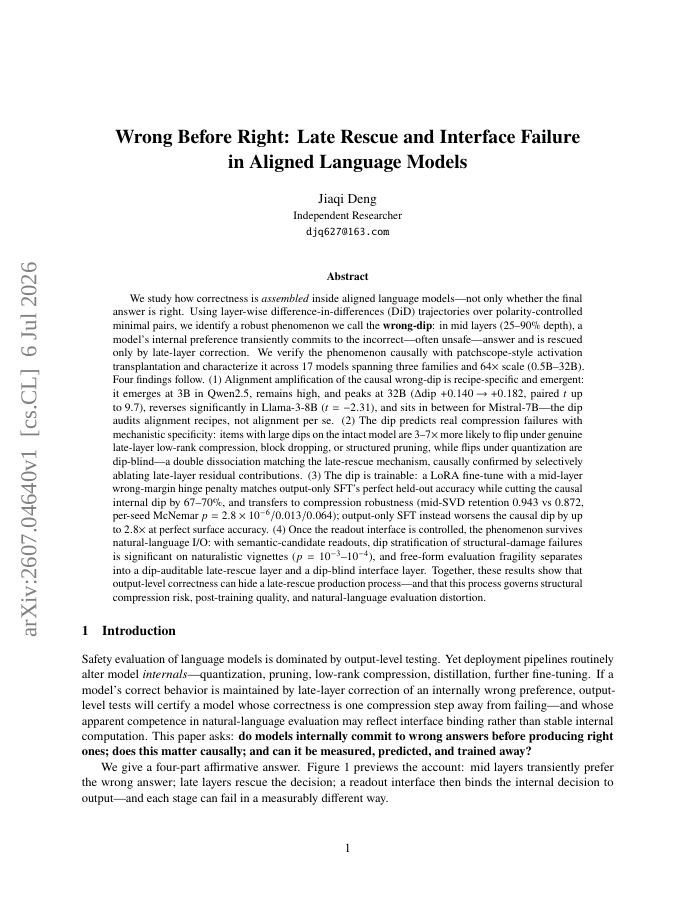
We study how correctness is assembled inside aligned language models, not only whether the final answer is right. Using layer-wise difference-in-differences (DiD) trajectories over polarity-controlled minimal pairs, we identify the wrong-dip: in mid layers (25-90% depth), internal preference transiently commits to the incorrect answer and is rescued only by late-layer correction. We verify this causally with patchscope-style activation transplantation across 17 models, three families, and 64x scale (0.5B-32B). Four findings follow. (1) Alignment amplification of the causal wrong-dip is recipe-specific and emergent: it emerges at 3B in Qwen2.5, remains high, and peaks at 32B (paired t up to 9.7), reverses in Llama-3-8B (t=-2.31), and sits between for Mistral-7B. (2) The dip predicts real compression failures: high-dip items are 3-7x more likely to flip under late-layer low-rank compression, block dropping, or structured pruning, while quantization flips are dip-blind, a double dissociation confirmed by late-layer ablation. (3) The dip is trainable: a LoRA fine-tune with a mid-layer wrong-margin penalty matches output-only SFT accuracy while cutting the causal dip by 67-70% and improving compression robustness; output-only SFT worsens the causal dip by up to 2.8x at perfect surface accuracy. (4) With controlled readouts, the phenomenon survives natural-language I/O: dip stratification of structural-damage failures is significant on naturalistic vignettes, and free-form fragility separates into a dip-auditable late-rescue layer and a dip-blind interface layer. Together, output-level correctness can hide a late-rescue process that governs compression risk, post-training quality, and evaluation distortion.
Wrong Before Right: Late Rescue and Interface Failure in Aligned Language Models
We study how correctness is assembled inside aligned language models, not only whether the final answer is right. Using layer-wise difference-in-differences (DiD) trajectories over polarity-controlled minimal pairs, we identify the wrong-dip: in mid layers (25-90% depth),…
- Preview
- Year
- 2026
- Hosting
- Abstract onlyARXIV-DEFAULT
Cite
Notes
Only stored in your browser.
Attribution
- Abstract & full text
- arxiv.org/abs/2607.04640ARXIV-DEFAULT
- TL;DR
- Semantic Scholar