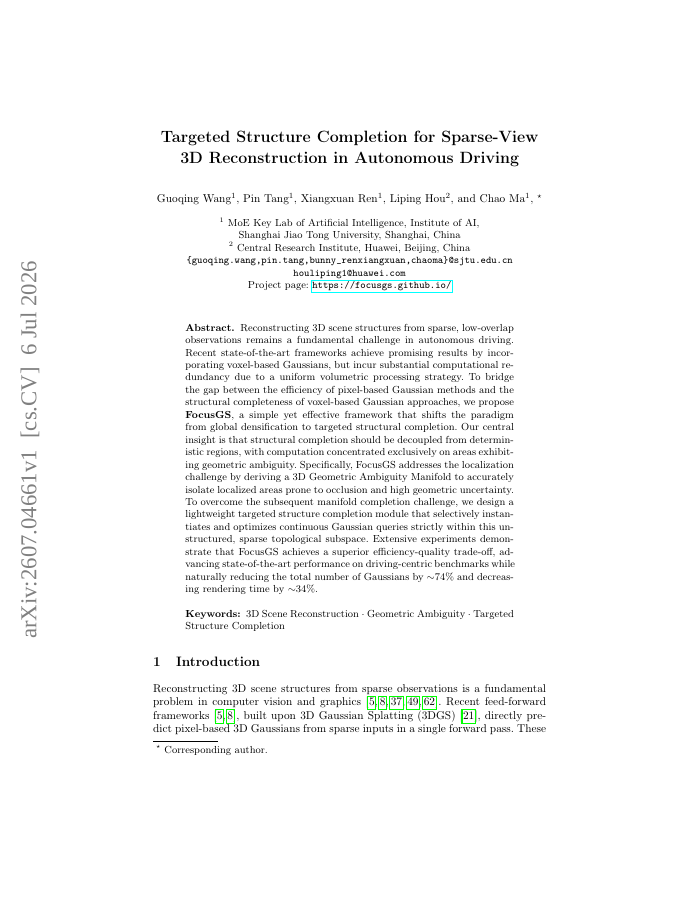
Reconstructing 3D scene structures from sparse, low-overlap observations remains a fundamental challenge in autonomous driving. Recent state-of-the-art frameworks achieve promising results by incorporating voxel-based Gaussians, but incur substantial computational redundancy due to a uniform volumetric processing strategy. To bridge the gap between the efficiency of pixel-based Gaussian methods and the structural completeness of voxel-based Gaussian approaches, we propose FocusGS, a simple yet effective framework that shifts the paradigm from global densification to targeted structural completion. Our central insight is that structural completion should be decoupled from deterministic regions, with computation concentrated exclusively on areas exhibiting geometric ambiguity. Specifically, FocusGS addresses the localization challenge by deriving a 3D Geometric Ambiguity Manifold to accurately isolate localized areas prone to occlusion and high geometric uncertainty. To overcome the subsequent manifold completion challenge, we design a lightweight targeted structure completion module that selectively instantiates and optimizes continuous Gaussian queries strictly within this unstructured, sparse topological subspace. Extensive experiments demonstrate that FocusGS achieves a superior efficiency-quality trade-off, advancing state-of-the-art performance on driving-centric benchmarks while naturally reducing the total number of Gaussians by 74% and decreasing rendering time by 34%.
Targeted Structure Completion for Sparse-View 3D Reconstruction in Autonomous Driving
Reconstructing 3D scene structures from sparse, low-overlap observations remains a fundamental challenge in autonomous driving. Recent state-of-the-art frameworks achieve promising results by incorporating voxel-based Gaussians, but incur substantial computational redundancy due…
- Preview
- Year
- 2026
- Hosting
- Full text hostedCC-BY-4.0
Cite
Notes
Only stored in your browser.
Attribution
- Abstract & full text
- arxiv.org/abs/2607.04661CC-BY-4.0
- TL;DR
- Semantic Scholar