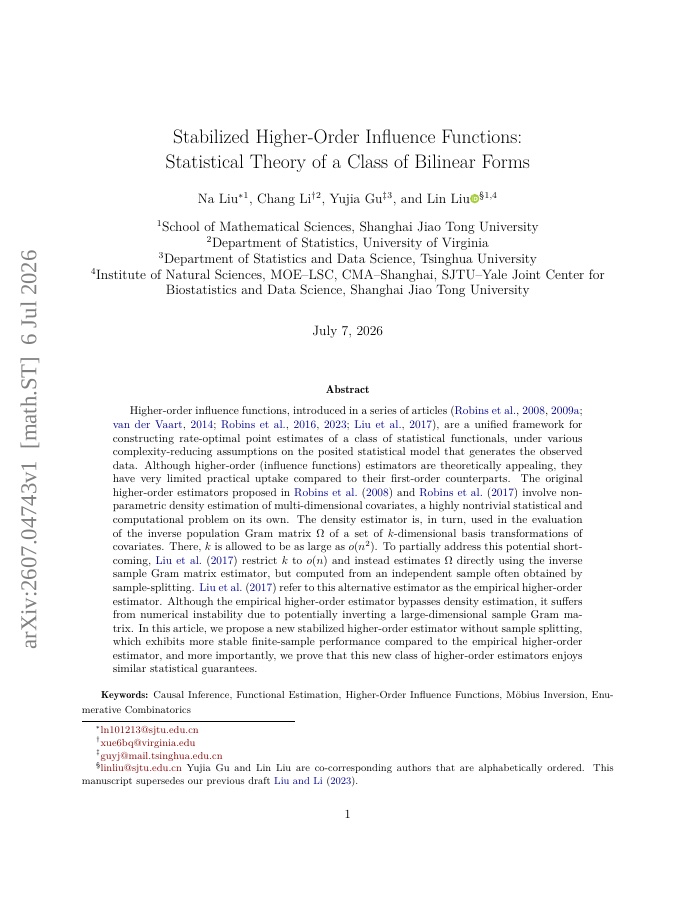
Higher-order influence functions, introduced in a series of articles (Robins et al., 2008, 2009a; van der Vaart, 2014; Robins et al., 2016, 2023; Liu et al., 2017), are a unified framework for constructing rate-optimal point estimates of a class of statistical functionals, under various complexity-reducing assumptions on the posited statistical model that generates the observed data. Although higher-order (influence functions) estimators are theoretically appealing, they have very limited practical uptake compared to their first-order counterparts. The original higher-order estimators proposed in Robins et al. (2008) and Robins et al. (2017) involve nonparametric density estimation of multi-dimensional covariates, a highly nontrivial statistical and computational problem on its own. The density estimator is, in turn, used in the evaluation of the inverse population Gram matrix Ω of a set of k-dimensional basis transformations of covariates. There, k is allowed to be as large as o (n^2). To partially address this potential shortcoming, Liu et al. (2017) restrict k to o (n) and instead estimate Ω directly using the inverse sample Gram matrix estimator, but computed from an independent sample often obtained by sample-splitting. Liu et al. (2017) refer to this alternative estimator as the empirical higher-order estimator. Although the empirical higher-order estimator bypasses density estimation, it suffers from numerical instability due to potentially inverting a large-dimensional sample Gram matrix. In this article, we propose a new stabilized higher-order estimator without sample splitting, which exhibits more stable finite-sample performance compared to the empirical higher-order estimator, and more importantly, we prove that this new class of higher-order estimators enjoys similar statistical guarantees.
Stabilized Higher-Order Influence Functions: Statistical Theory of a Class of Bilinear Forms
Higher-order influence functions, introduced in a series of articles (Robins et al., 2008, 2009a; van der Vaart, 2014; Robins et al., 2016, 2023; Liu et al., 2017), are a unified framework for constructing rate-optimal point estimates of a class of statistical functionals, under…
- Preview
- Year
- 2026
- Hosting
- Abstract onlyARXIV-DEFAULT
Cite
Notes
Only stored in your browser.
Attribution
- Abstract & full text
- arxiv.org/abs/2607.04743ARXIV-DEFAULT
- TL;DR
- Semantic Scholar