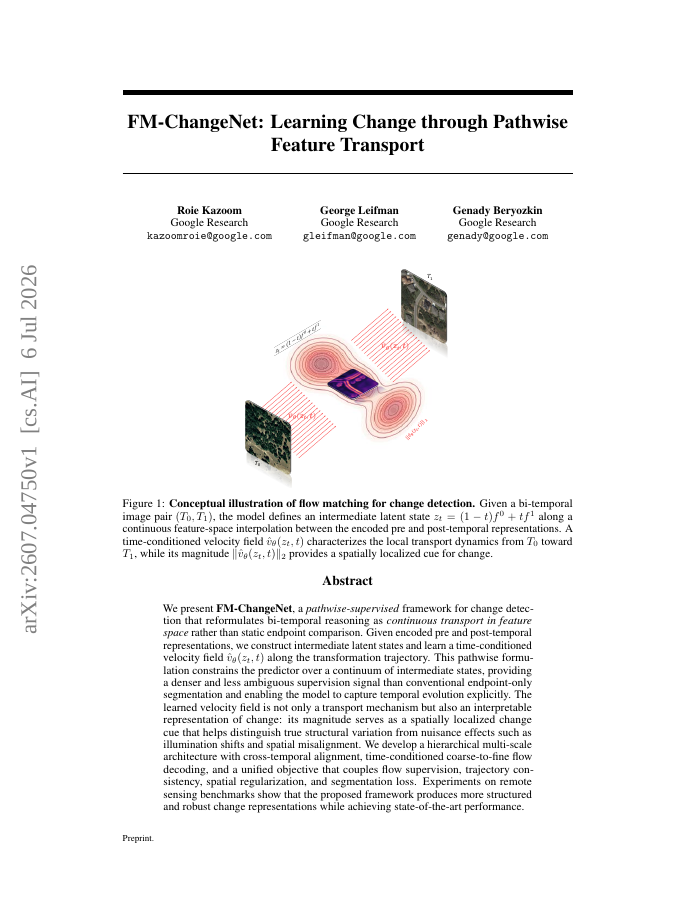
We present FM-ChangeNet, a pathwise-supervised framework for change detection that reformulates bi-temporal reasoning as continuous transport in feature space rather than static endpoint comparison. Given encoded pre and post-temporal representations, we construct intermediate latent states and learn a time-conditioned velocity field \hat{v}_θ(z_t,t) along the transformation trajectory. This pathwise formulation constrains the predictor over a continuum of intermediate states, providing a denser and less ambiguous supervision signal than conventional endpoint-only segmentation and enabling the model to capture temporal evolution explicitly. The learned velocity field is not only a transport mechanism but also an interpretable representation of change: its magnitude serves as a spatially localized change cue that helps distinguish true structural variation from nuisance effects such as illumination shifts and spatial misalignment. We develop a hierarchical multi-scale architecture with cross-temporal alignment, time-conditioned coarse-to-fine flow decoding, and a unified objective that couples flow supervision, trajectory consistency, spatial regularization, and segmentation loss. Experiments on remote sensing benchmarks show that the proposed framework produces more structured and robust change representations while achieving state-of-the-art performance.
FM-ChangeNet: Learning Change through Pathwise Feature Transport
We present FM-ChangeNet, a pathwise-supervised framework for change detection that reformulates bi-temporal reasoning as continuous transport in feature space rather than static endpoint comparison.
- Preview
- Year
- 2026
- Hosting
- Full text hostedCC-BY-4.0
Cite
Notes
Only stored in your browser.
Attribution
- Abstract & full text
- arxiv.org/abs/2607.04750CC-BY-4.0
- TL;DR
- Semantic Scholar