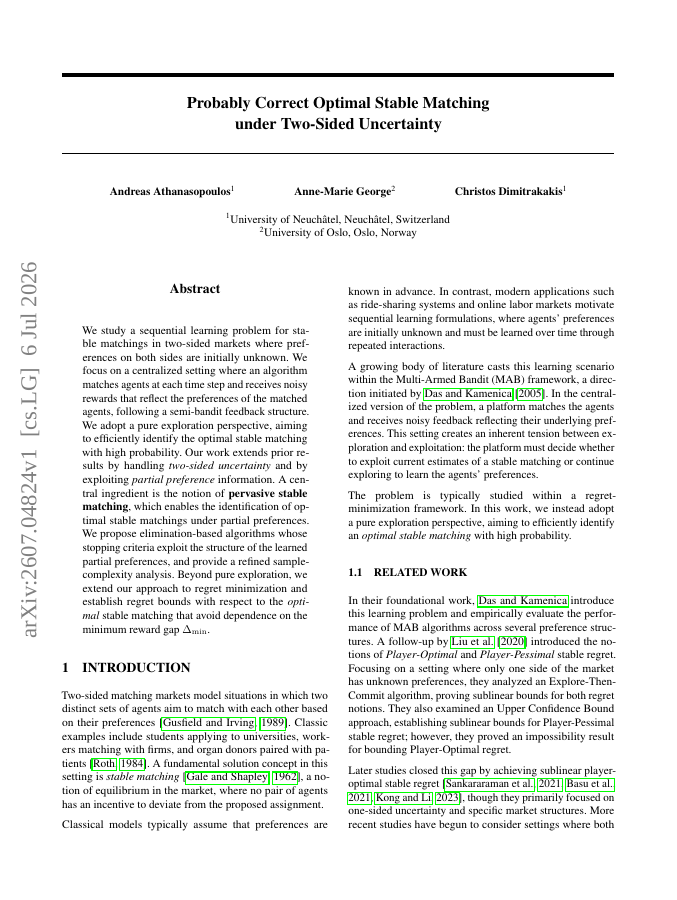
We study a sequential learning problem for stable matchings in two-sided markets where preferences on both sides are initially unknown. We focus on a centralized setting where an algorithm matches agents at each time step and receives noisy rewards that reflect the preferences of the matched agents, following a semi-bandit feedback structure. We adopt a pure exploration perspective, aiming to efficiently identify the optimal stable matching with high probability. Our work extends prior results by handling two-sided uncertainty and by exploiting partial preference information. A central ingredient is the notion of pervasive stable matching, which enables the identification of optimal stable matchings under partial preferences. We propose elimination-based algorithms whose stopping criteria exploit the structure of the learned partial preferences, and provide a refined sample-complexity analysis. Beyond pure exploration, we extend our approach to regret minimization and establish regret bounds with respect to the optimal stable matching that avoid dependence on the minimum reward gap Δ_{\min}.
Probably Correct Optimal Stable Matching under Two-Sided Uncertainty
We study a sequential learning problem for stable matchings in two-sided markets where preferences on both sides are initially unknown. We focus on a centralized setting where an algorithm matches agents at each time step and receives noisy rewards that reflect the preferences…
- Preview
- Year
- 2026
- Hosting
- Full text hostedCC-BY-4.0
Cite
Notes
Only stored in your browser.
Attribution
- Abstract & full text
- arxiv.org/abs/2607.04824CC-BY-4.0
- TL;DR
- Semantic Scholar