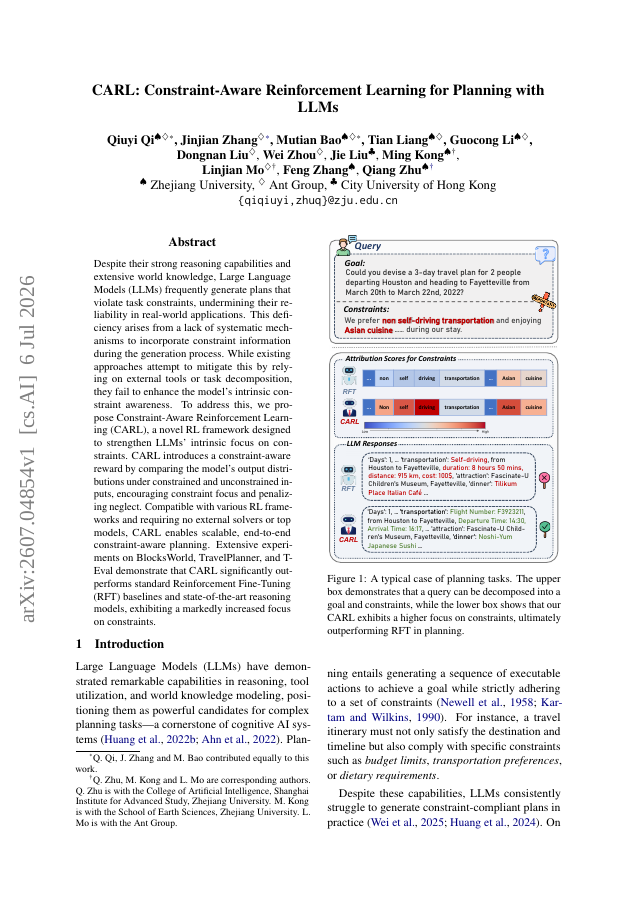
Despite their strong reasoning capabilities and extensive world knowledge, Large Language Models (LLMs) frequently generate plans that violate task constraints, undermining their reliability in real-world applications. This deficiency arises from a lack of systematic mechanisms to incorporate constraint information during the generation process. While existing approaches attempt to mitigate this by relying on external tools or task decomposition, they fail to enhance the model's intrinsic constraint awareness. To address this, we propose Constraint-Aware Reinforcement Learning (CARL), a novel RL framework designed to strengthen LLMs' intrinsic focus on constraints. CARL introduces a constraint-aware reward by comparing the model's output distributions under constrained and unconstrained inputs, encouraging constraint focus and penalizing neglect. Compatible with various RL frameworks and requiring no external solvers or top models, CARL enables scalable, end-to-end constraint-aware planning. Extensive experiments on BlocksWorld, TravelPlanner, and T-Eval demonstrate that CARL significantly outperforms standard Reinforcement Fine-Tuning (RFT) baselines and state-of-the-art reasoning models, exhibiting a markedly increased focus on constraints.
CARL: Constraint-Aware Reinforcement Learning for Planning with LLMs
Despite their strong reasoning capabilities and extensive world knowledge, Large Language Models (LLMs) frequently generate plans that violate task constraints, undermining their reliability in real-world applications.
- Preview
- Year
- 2026
- Hosting
- Abstract onlyARXIV-DEFAULT
Cite
Notes
Only stored in your browser.
Attribution
- Abstract & full text
- arxiv.org/abs/2607.04854ARXIV-DEFAULT
- TL;DR
- Semantic Scholar