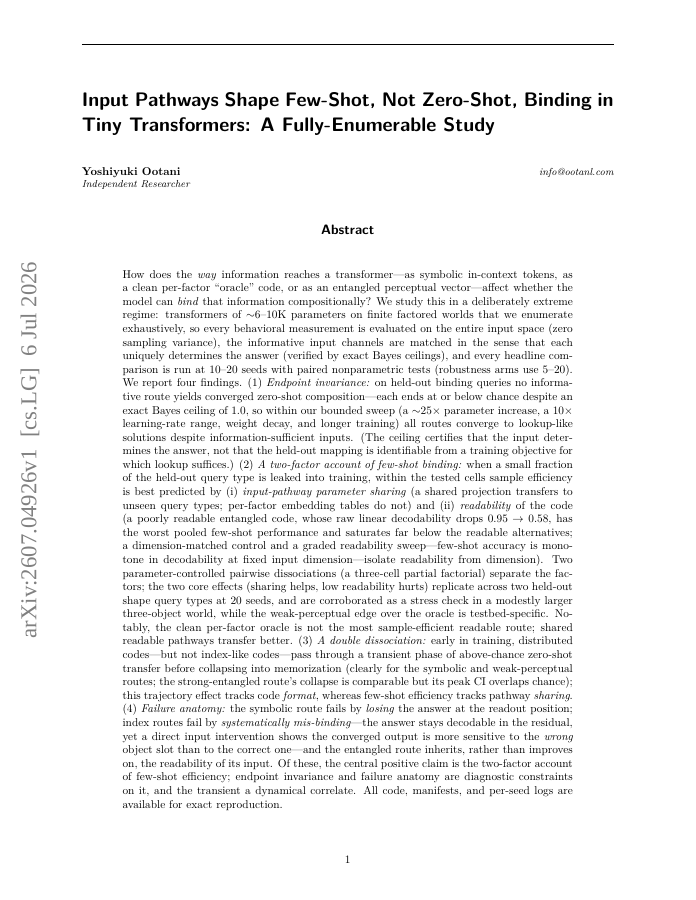
How does the way information reaches a transformer -- as symbolic tokens, a clean per-factor "oracle" code, or an entangled perceptual vector -- shape whether it binds that information compositionally? We study 6-10K-parameter transformers on finite factored worlds enumerated exhaustively, so every measurement covers the whole input space (zero sampling variance) and the informative routes are information-matched (exact Bayes ceiling 1.0). We report four findings. (1) Endpoint invariance: on held-out binding queries no informative route reaches converged zero-shot composition -- each ends at or below chance despite a ceiling of 1.0, so within a bounded sweep the failure reflects inductive bias under a lookup-sufficient objective, not missing information. (2) A two-factor account of few-shot binding: sample efficiency is best explained by input-pathway parameter sharing and code readability; a dimension-matched control and a graded readability sweep isolate readability from input dimension, and the clean oracle is not the most sample-efficient readable route. (3) A double dissociation: early in training, distributed -- but not index-like -- codes pass through a transient above-chance phase (tracking code format), while few-shot efficiency tracks pathway sharing. (4) Failure anatomy: symbolic routes lose the answer at the readout; index routes mis-bind (the answer stays decodable, yet an input intervention shows the output tracks the wrong slot); entangled routes inherit their input's readability. The central claim is the two-factor account; the endpoint and anatomy results are diagnostic constraints. All code, manifests, and per-seed logs are released for exact reproduction.
Input Pathways Shape Few-Shot, Not Zero-Shot, Binding in Tiny Transformers: A Fully-Enumerable Study
How does the way information reaches a transformer -- as symbolic tokens, a clean per-factor "oracle" code, or an entangled perceptual vector -- shape whether it binds that information compositionally? We study ~6-10K-parameter transformers on finite factored worlds…
- Preview
- Year
- 2026
- Hosting
- Full text hostedCC-BY-4.0
Cite
Notes
Only stored in your browser.
Attribution
- Abstract & full text
- arxiv.org/abs/2607.04926CC-BY-4.0
- TL;DR
- Semantic Scholar