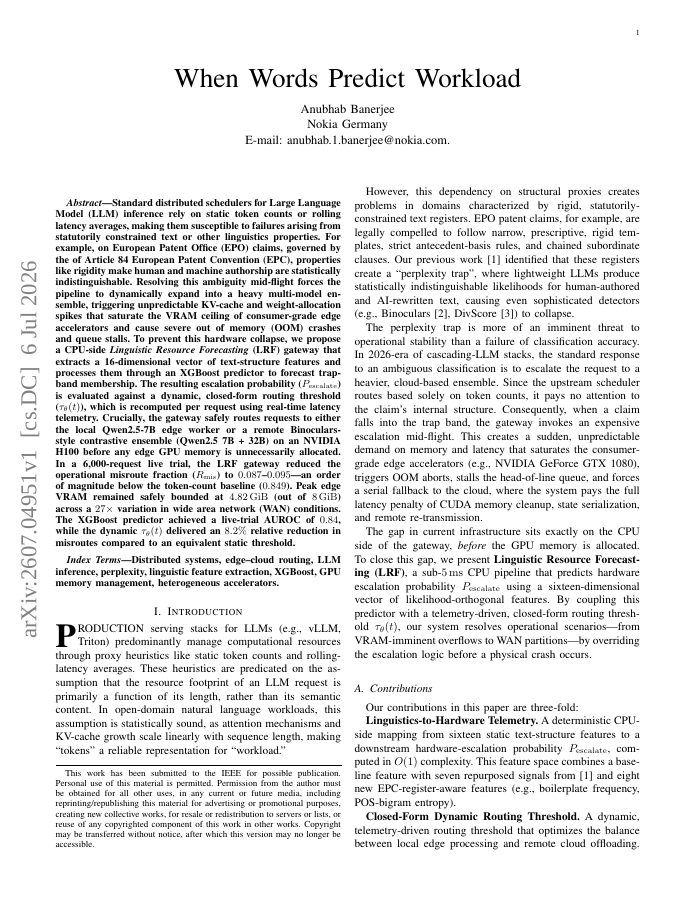
Standard distributed \ac{llm} schedulers rely on static token counts or rolling latency averages, making them susceptible to failures on statutorily constrained text. On \ac{epo} claims governed by Article 84 \ac{epc}, linguistic rigidity makes human and machine authorship statistically indistinguishable. Resolving this ambiguity mid-flight forces dynamic multi-model ensemble expansion, triggering unpredictable KV-cache and weight-allocation spikes that saturate consumer-grade edge GPU VRAM and cause severe \ac{oom} crashes. To prevent hardware collapse, we propose a CPU-side Linguistic Resource Forecasting (LRF) gateway. The gateway extracts a 16-dimensional text-structure vector and applies an XGBoost predictor to forecast trap-band membership. The resulting escalation probability (\Pesc) is evaluated against a dynamic, closed-form routing threshold (\Tauroute(t)) computed via real-time latency telemetry. Requests are safely routed to either a local Qwen2.5-7B edge worker or a remote contrastive ensemble (Qwen2.5 7B + 32B) on an NVIDIA H100 before any edge GPU memory is allocated. In a 6,000-request live trial, the LRF gateway reduced the operational misroute fraction (R_{mis}) to 0.087--0.095, an order of magnitude below the token-count baseline (0.849). Peak edge VRAM remained safely bounded at \SI{4.82}{\gibi\byte} (under the \SI{8}{\gibi\byte} ceiling) across a 27\times variation in \ac{wan} delay. The predictor achieved a live-trial AUROC of 0.84, and the dynamic \Tauroute(t) controller yielded an 8.2% relative reduction in misroutes compared to an equivalent static threshold.
When Words Predict Workload
Standard distributed \ac{llm} schedulers rely on static token counts or rolling latency averages, making them susceptible to failures on statutorily constrained text. On \ac{epo} claims governed by Article 84 \ac{epc}, linguistic rigidity makes human and machine authorship…
- Preview
- Year
- 2026
- Hosting
- Excerpt onlyCC-BY-NC-4.0
Cite
Notes
Only stored in your browser.
Attribution
- Abstract & full text
- arxiv.org/abs/2607.04951CC-BY-NC-4.0
- TL;DR
- Semantic Scholar