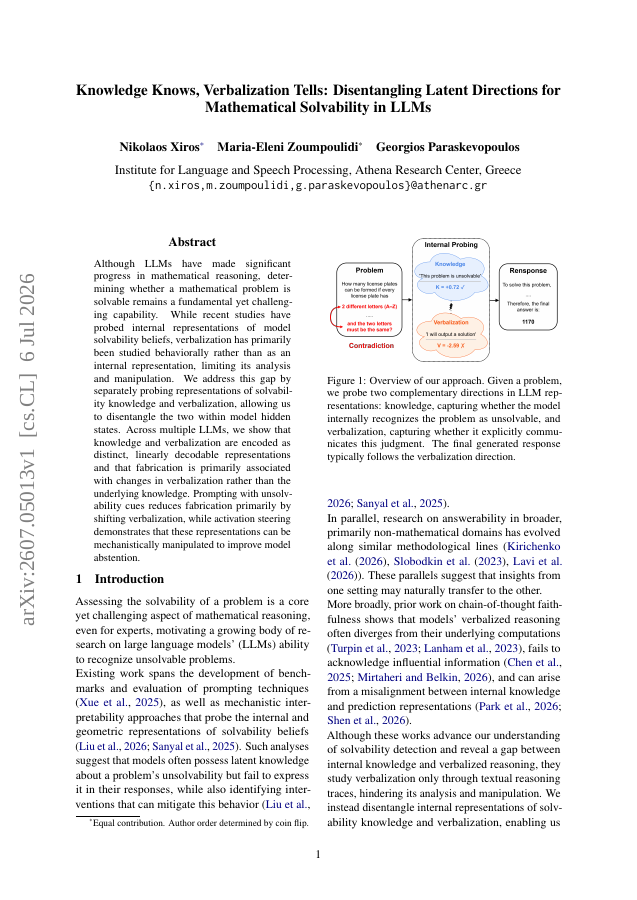
Although LLMs have made significant progress in mathematical reasoning, determining whether a mathematical problem is solvable remains a fundamental yet challenging capability. While recent studies have probed internal representations of model solvability beliefs, verbalization has primarily been studied behaviorally rather than as an internal representation, limiting its analysis and manipulation. We address this gap by separately probing representations of solvability knowledge and verbalization, allowing us to disentangle the two within model hidden states. Across multiple LLMs, we show that knowledge and verbalization are encoded as distinct, linearly decodable representations and that fabrication is primarily associated with changes in verbalization rather than the underlying knowledge. Prompting with unsolvability cues reduces fabrication primarily by shifting verbalization, while activation steering demonstrates that these representations can be echanistically manipulated to improve model abstention.
Knowledge Knows, Verbalization Tells: Disentangling Latent Directions for Mathematical Solvability in LLMs
Although LLMs have made significant progress in mathematical reasoning, determining whether a mathematical problem is solvable remains a fundamental yet challenging capability.
- Preview
- Year
- 2026
- Hosting
- Full text hostedCC-BY-4.0
Cite
Notes
Only stored in your browser.
Attribution
- Abstract & full text
- arxiv.org/abs/2607.05013CC-BY-4.0
- TL;DR
- Semantic Scholar