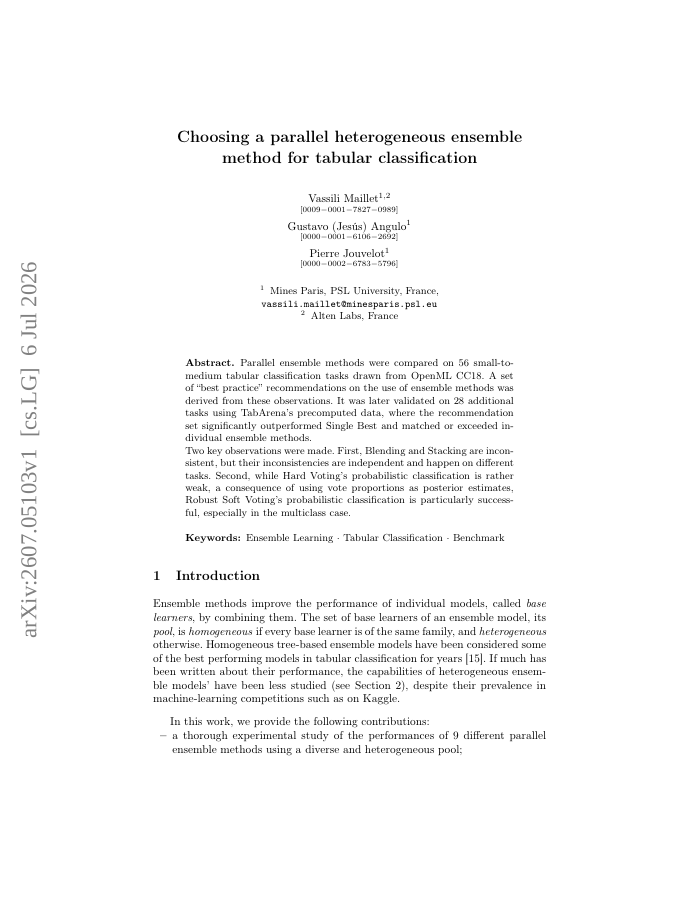
Parallel ensemble methods were compared on 56 small-to-medium tabular classification tasks drawn from OpenML CC18. A set of ``best practice'' recommendations on the use of ensemble methods was derived from these observations. It was later validated on 28 additional tasks using TabArena's precomputed data, where the recommendation set significantly outperformed Single Best and matched or exceeded individual ensemble methods. Two key observations were made. First, Blending and Stacking are inconsistent, but their inconsistencies are independent and happen on different tasks. Second, while Hard Voting's probabilistic classification is rather weak, a consequence of using vote proportions as posterior estimates, Robust Soft Voting's probabilistic classification is particularly successful, especially in the multiclass case.
Choosing a parallel heterogeneous ensemble method for tabular classification
Parallel ensemble methods were compared on $56$ small-to-medium tabular classification tasks drawn from OpenML CC18. A set of ``best practice'' recommendations on the use of ensemble methods was derived from these observations.
- Preview
- Year
- 2026
- Hosting
- Excerpt onlyCC-BY-NC-SA-4.0
Cite
Notes
Only stored in your browser.
Attribution
- Abstract & full text
- arxiv.org/abs/2607.05103CC-BY-NC-SA-4.0
- TL;DR
- Semantic Scholar