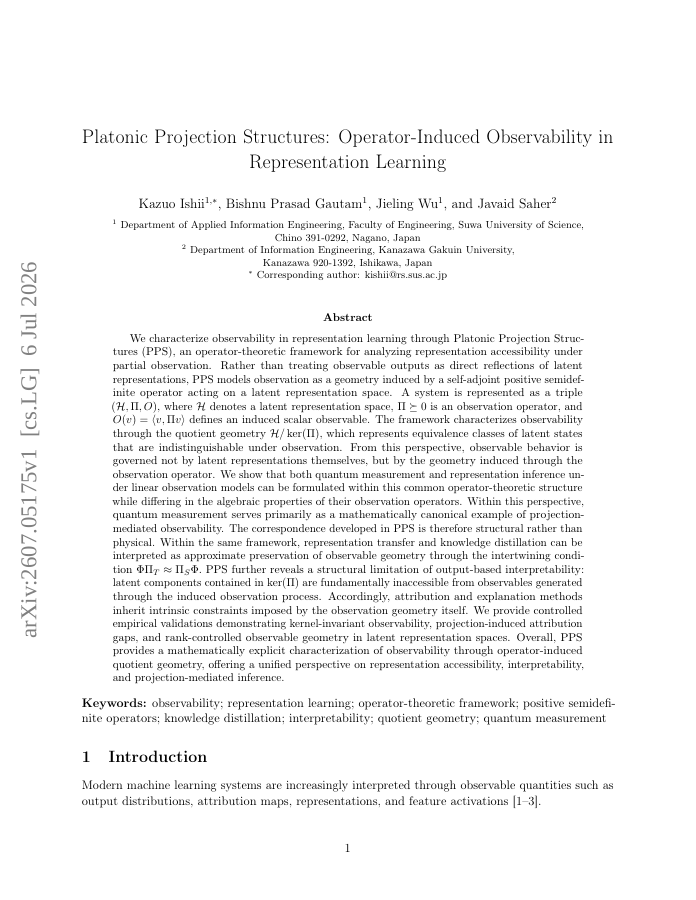
We characterize observability in representation learning through Platonic Projection Structures (PPS), an operator-theoretic framework for analyzing representation accessibility under partial observation. Rather than treating observable outputs as direct reflections of latent representations, PPS models observation through a self-adjoint positive semidefinite operator acting on a latent representation space. A system is represented as a triple (H, Π, O), where H is a latent representation space, Π\succeq 0 is an observation operator, and O(v)=\langle v,Πv\rangle defines an induced scalar observable. Observability is characterized by the quotient geometry H/\ker(Π), representing equivalence classes of latent states indistinguishable under observation. We show that quantum measurement and representation inference under linear observation models share this operator-theoretic structure while differing in the algebraic properties of their observation operators; the correspondence is structural rather than physical. Representation transfer and knowledge distillation can likewise be interpreted as approximate preservation of observable geometry through ΦΠ_T \approx Π_S Φ. PPS also reveals a structural limitation of output-based interpretability: latent components in \ker(Π) are inaccessible from induced observables, imposing intrinsic constraints on attribution and explanation methods. Controlled empirical validations demonstrate kernel-invariant observability, projection-induced attribution gaps, and rank-controlled observable geometry in latent representation spaces. PPS thus provides an explicit characterization of observability through operator-induced quotient geometry and a unified perspective on representation accessibility, interpretability, and projection-mediated inference.
Platonic Projection Structures: Operator-Induced Observability in Representation Learning
We characterize observability in representation learning through Platonic Projection Structures (PPS), an operator-theoretic framework for analyzing representation accessibility under partial observation.
- Preview
- Year
- 2026
- Hosting
- Full text hostedCC-BY-4.0
Cite
Notes
Only stored in your browser.
Attribution
- Abstract & full text
- arxiv.org/abs/2607.05175CC-BY-4.0
- TL;DR
- Semantic Scholar