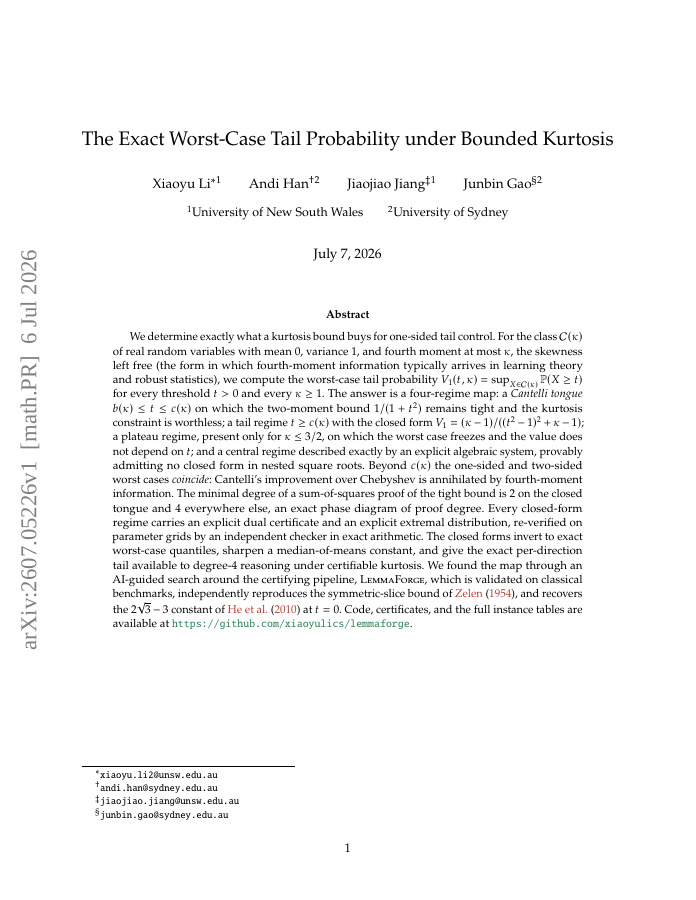
We determine exactly what a kurtosis bound buys for one-sided tail control. For the class C(κ) of real random variables with mean 0, variance 1, and fourth moment at most κ, the skewness left free, we compute the worst-case tail probability V_1(t,κ)=\sup_{X\inC(κ)}\mathbb{P}(X\geq t) for every threshold t>0 and every κ\geq 1. The answer is a four-regime map: a Cantelli tongue b(κ)\le t\le c(κ) on which the two-moment bound 1/(1+t^2) remains tight and the kurtosis constraint is worthless; a tail regime t\geq c(κ) with the closed form V_1=(κ-1)/((t^2-1)^2+κ-1); a plateau regime, present only for κ\le 3/2, on which the worst case freezes and the value does not depend on t; and a central regime described exactly by an explicit algebraic system, provably admitting no closed form in nested square roots. Beyond c(κ) the one-sided and two-sided worst cases coincide: Cantelli's improvement over Chebyshev is annihilated by fourth-moment information. The minimal degree of a sum-of-squares proof of the tight bound is 2 on the closed tongue and 4 everywhere else, an exact phase diagram of proof degree. Every closed-form regime carries an explicit dual certificate and an explicit extremal distribution, re-verified on parameter grids by an independent checker in exact arithmetic. The closed forms invert to exact worst-case quantiles, sharpen a median-of-means constant, and give the exact per-direction tail available to degree-4 reasoning under certifiable kurtosis. We found the map through an AI-guided search around the certifying pipeline, LemmaForge, which is validated on classical benchmarks, independently reproduces the symmetric-slice bound of Zelen (1954), and recovers the 2\sqrt{3}-3 constant of He, Zhang, and Zhang (2010) at t=0.
The Exact Worst-Case Tail Probability under Bounded Kurtosis
We determine exactly what a kurtosis bound buys for one-sided tail control. For the class $\mathcal{C}(κ)$ of real random variables with mean $0$, variance $1$, and fourth moment at most $κ$, the skewness left free, we compute the worst-case tail probability…
- Preview
- Year
- 2026
- Hosting
- Full text hostedCC-BY-4.0
Cite
Notes
Only stored in your browser.
Attribution
- Abstract & full text
- arxiv.org/abs/2607.05226CC-BY-4.0
- TL;DR
- Semantic Scholar