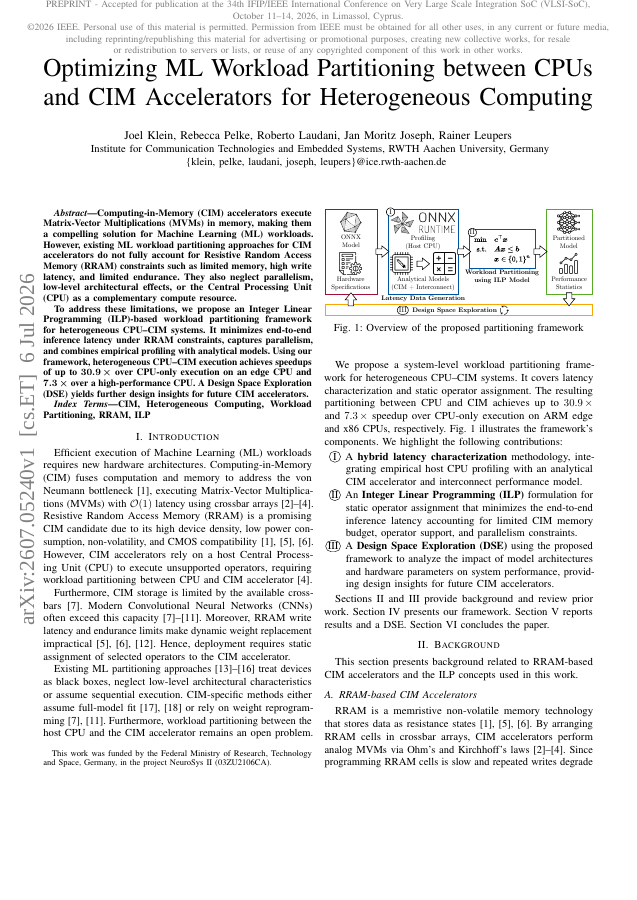
Computing-in-Memory (CIM) accelerators execute Matrix-Vector Multiplications (MVMs) in memory, making them a compelling solution for Machine Learning (ML) workloads. However, existing ML workload partitioning approaches for CIM accelerators do not fully account for Resistive Random Access Memory (RRAM) constraints such as limited memory, high write latency, and limited endurance. They also neglect parallelism, low-level architectural effects, or the Central Processing Unit (CPU) as a complementary compute resource. To address these limitations, we propose an Integer Linear Programming (ILP)-based workload partitioning framework for heterogeneous CPU-CIM systems. It minimizes end-to-end inference latency under RRAM constraints, captures parallelism, and combines empirical profiling with analytical models. Using our framework, heterogeneous CPU-CIM execution achieves speedups of up to 30.9x over CPU-only execution on an edge CPU and 7.3x over a high-performance CPU. A Design Space Exploration (DSE) yields further design insights for future CIM accelerators.
Optimizing ML Workload Partitioning between CPUs and CIM Accelerators for Heterogeneous Computing
Computing-in-Memory (CIM) accelerators execute Matrix-Vector Multiplications (MVMs) in memory, making them a compelling solution for Machine Learning (ML) workloads. However, existing ML workload partitioning approaches for CIM accelerators do not fully account for Resistive…
- Preview
- Year
- 2026
- Hosting
- Abstract onlyARXIV-DEFAULT
Cite
Notes
Only stored in your browser.
Attribution
- Abstract & full text
- arxiv.org/abs/2607.05240ARXIV-DEFAULT
- TL;DR
- Semantic Scholar