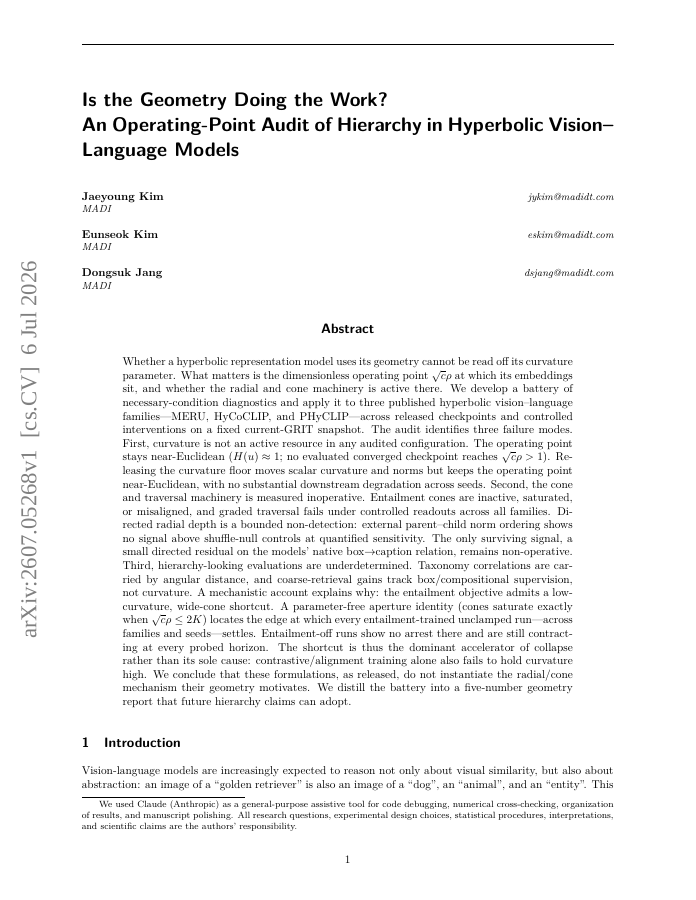
Whether a hyperbolic representation model uses its geometry cannot be read off its curvature parameter: what matters is the dimensionless operating point \sqrt{c}ρ and whether the radial and cone machinery is active there. We develop a battery of necessary-condition diagnostics and audit three published hyperbolic vision-language families -- MERU, HyCoCLIP, and PHyCLIP -- across released checkpoints and controlled interventions on a fixed GRIT snapshot, identifying three failure modes. First, curvature is not an active resource: the operating point stays near-Euclidean (H(u)\approx 1; no audited converged checkpoint reaches \sqrt{c}ρ>1), and releasing the curvature floor moves curvature and norms but keeps the operating point near-Euclidean, without substantial downstream degradation. Second, the cone and traversal machinery is measured inoperative: entailment cones are inactive, saturated, or misaligned, and graded traversal fails under controlled readouts, while directed radial depth is a bounded non-detection above shuffle-null controls at quantified sensitivity; the one surviving native-relation residual remains non-operative. Third, hierarchy-looking evaluations are underdetermined: taxonomy correlations are carried by angular distance, and coarse-retrieval gains track box/compositional supervision, not curvature. A mechanistic account explains why: the entailment objective admits a low-curvature, wide-cone shortcut, and a parameter-free aperture identity (cones saturate iff \sqrt{c}ρ\le 2K) locates the edge where every entailment-trained unclamped run settles; entailment-off runs show no arrest there. The shortcut is the dominant accelerator of collapse, not its sole cause. These formulations, as released, do not instantiate the radial/cone mechanism their geometry motivates; we distill the audit into a five-number geometry report for future hierarchy claims.
Is the Geometry Doing the Work? An Operating-Point Audit of Hierarchy in Hyperbolic Vision-Language Models
Whether a hyperbolic representation model uses its geometry cannot be read off its curvature parameter: what matters is the dimensionless operating point $\sqrt{c}ρ$ and whether the radial and cone machinery is active there.
- Preview
- Year
- 2026
- Hosting
- Abstract onlyARXIV-DEFAULT
Cite
Notes
Only stored in your browser.
Attribution
- Abstract & full text
- arxiv.org/abs/2607.05268ARXIV-DEFAULT
- TL;DR
- Semantic Scholar