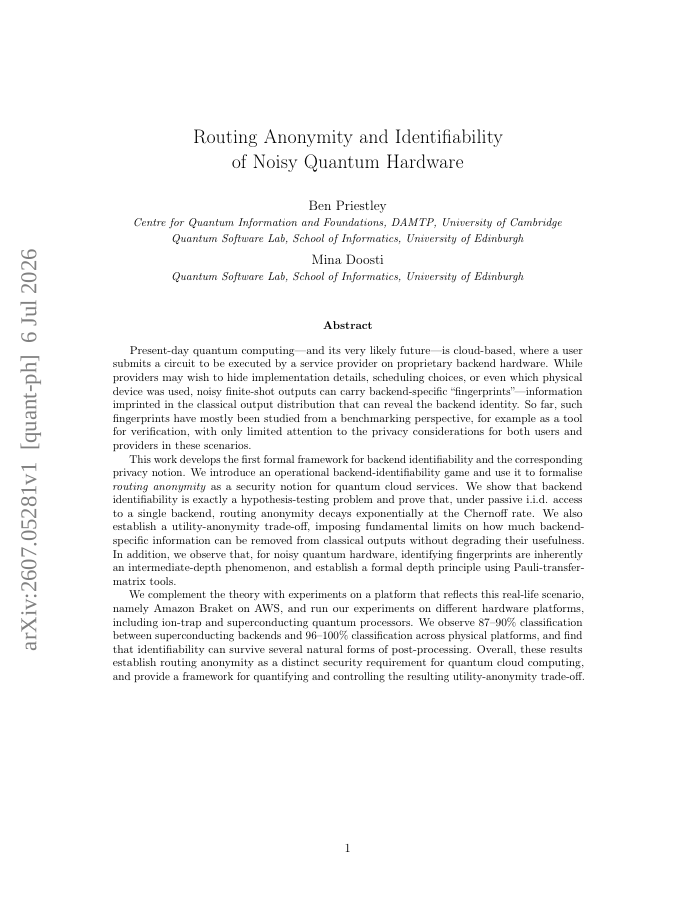
Present-day quantum computing is cloud-based, where a user submits a circuit to a service provider's proprietary backend hardware. While providers may wish to hide implementation details, scheduling choices, or even which physical device was used, noisy finite-shot outputs can carry backend-specific fingerprints: information imprinted in the classical output distribution that can reveal the backend identity. So far, such fingerprints have mostly been studied from a benchmarking perspective, with limited attention to privacy considerations for users and providers. This work develops the first formal framework for backend identifiability and its privacy implications. We introduce a backend-identifiability game and use it to formalise routing anonymity as a security notion for quantum cloud services. We show that backend identifiability is a hypothesis-testing problem and prove that, under passive i.i.d. access to a single backend, routing anonymity decays exponentially at the Chernoff rate. We also establish a utility-anonymity trade-off, imposing fundamental limits on how much backend-specific information can be removed from classical outputs without degrading their usefulness. In addition, we observe that, for noisy quantum hardware, identifying fingerprints are inherently an intermediate-depth phenomenon, and establish a depth principle using Pauli-transfer-matrix tools. We complement the theory with experiments on Amazon Braket on AWS, using ion-trap and superconducting quantum processors. We observe 87-90% classification between superconducting backends and 96-100% classification across physical platforms, and find that identifiability can survive natural forms of post-processing. Overall, these results establish routing anonymity as a distinct security requirement for quantum cloud computing, and provide a framework for quantifying and controlling the utility-anonymity trade-off.
Routing Anonymity and Identifiability of Noisy Quantum Hardware
Present-day quantum computing is cloud-based, where a user submits a circuit to a service provider's proprietary backend hardware. While providers may wish to hide implementation details, scheduling choices, or even which physical device was used, noisy finite-shot outputs can…
- Preview
- Year
- 2026
- Hosting
- Full text hostedCC-BY-4.0
Cite
Notes
Only stored in your browser.
Attribution
- Abstract & full text
- arxiv.org/abs/2607.05281CC-BY-4.0
- TL;DR
- Semantic Scholar