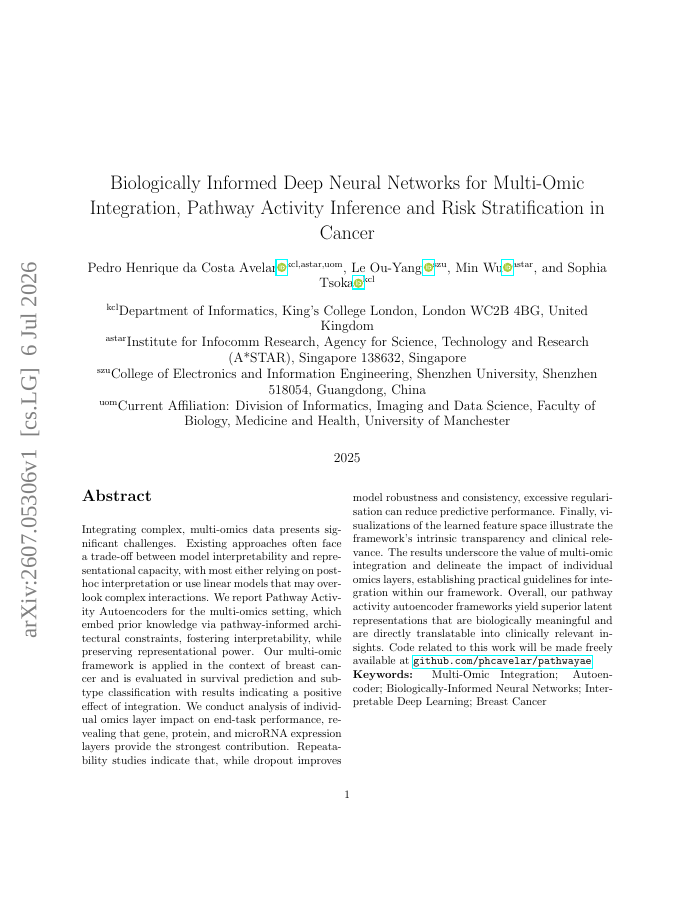
Integrating complex, multi-omics data presents significant challenges. Existing approaches often face a trade-off between model interpretability and representational capacity, with most either relying on post-hoc interpretation or use linear models that may overlook complex interactions. We report Pathway Activity Autoencoders for the multi-omics setting, which embed prior knowledge via pathway-informed architectural constraints, fostering interpretability, while preserving representational power. Our multi-omic framework is applied in the context of breast cancer and is evaluated in survival prediction and subtype classification with results indicating a positive effect of integration. We conduct analysis of individual omics layer impact on end-task performance, revealing that gene, protein, and microRNA expression layers provide the strongest contribution. Repeatability studies indicate that, while dropout improves model robustness and consistency, excessive regularisation can reduce predictive performance. Finally, visualizations of the learned feature space illustrate the framework's intrinsic transparency and clinical relevance. The results underscore the value of multi-omic integration and delineate the impact of individual omics layers, establishing practical guidelines for integration within our framework. Overall, our pathway activity autoencoder frameworks yield superior latent representations that are biologically meaningful and are directly translatable into clinically relevant insights.
Biologically Informed Deep Neural Networks for Multi-Omic Integration, Pathway Activity Inference and Risk Stratification in Cancer
Integrating complex, multi-omics data presents significant challenges. Existing approaches often face a trade-off between model interpretability and representational capacity, with most either relying on post-hoc interpretation or use linear models that may overlook complex…
- Preview
- Year
- 2026
- Hosting
- Abstract onlyARXIV-DEFAULT
Cite
Notes
Only stored in your browser.
Attribution
- Abstract & full text
- arxiv.org/abs/2607.05306ARXIV-DEFAULT
- TL;DR
- Semantic Scholar