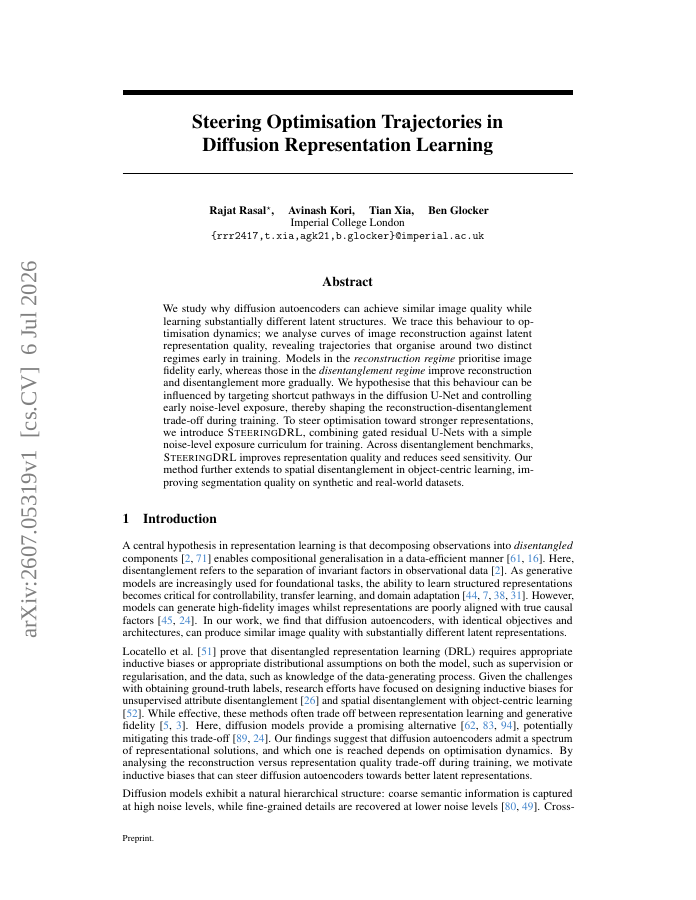
We study why diffusion autoencoders can achieve similar image quality while learning substantially different latent structures. We trace this behaviour to optimisation dynamics; we analyse curves of image reconstruction against latent representation quality, revealing trajectories that organise around two distinct regimes early in training. Models in the reconstruction regime prioritise image fidelity early, whereas those in the disentanglement regime improve reconstruction and disentanglement more gradually. We hypothesise that this behaviour can be influenced by targeting shortcut pathways in the diffusion U-Net and controlling early noise-level exposure, thereby shaping the reconstruction-disentanglement trade-off during training. To steer optimisation toward stronger representations, we introduce SteeringDRL, combining gated residual U-Nets with a simple noise-level exposure curriculum for training. Across disentanglement benchmarks, SteeringDRL improves representation quality and reduces seed sensitivity. Our method further extends to spatial disentanglement in object-centric learning, improving segmentation quality on synthetic and real-world datasets.
Steering Optimisation Trajectories in Diffusion Representation Learning
We study why diffusion autoencoders can achieve similar image quality while learning substantially different latent structures. We trace this behaviour to optimisation dynamics; we analyse curves of image reconstruction against latent representation quality, revealing…
- Preview
- Year
- 2026
- Hosting
- Full text hostedCC-BY-4.0
Cite
Notes
Only stored in your browser.
Attribution
- Abstract & full text
- arxiv.org/abs/2607.05319CC-BY-4.0
- TL;DR
- Semantic Scholar