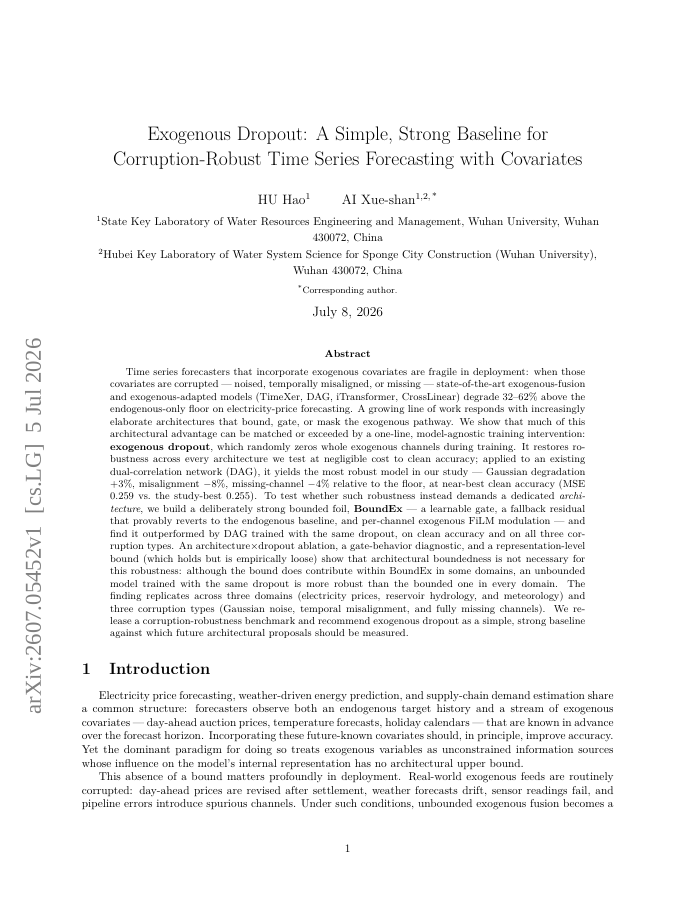
Time series forecasters that use exogenous covariates are fragile in deployment: when those covariates are noised, temporally misaligned, or missing, strong exogenous-fusion and exogenous-adapted models can degrade far above the endogenous-only floor. We study whether such robustness requires specialized architectures, or whether it can be obtained through a simple training intervention. We propose exogenous dropout, a model-agnostic method that randomly zeros whole exogenous channels during training. Across electricity-price forecasting, reservoir hydrology, and meteorology, exogenous dropout substantially improves robustness under Gaussian noise, temporal misalignment, and fully missing channels, while preserving clean accuracy. Applied to a dual-correlation network, it yields the most robust model in our experiments, outperforming a deliberately strong bounded architectural foil, BoundEx, which combines a learnable gate, a fallback residual to the endogenous backbone, and per-channel exogenous FiLM modulation. Architecture-by-dropout ablations, gate-behavior diagnostics, and a representation-level bound show that explicit architectural boundedness is not necessary for this robustness: an unbounded model trained with exogenous dropout is more robust than the bounded model in every domain. We release a corruption-robustness benchmark and recommend exogenous dropout as a simple, strong baseline for future work on time series forecasting with covariates.
Exogenous Dropout: A Simple, Strong Baseline for Corruption-Robust Time Series Forecasting with Covariates
Time series forecasters that use exogenous covariates are fragile in deployment: when those covariates are noised, temporally misaligned, or missing, strong exogenous-fusion and exogenous-adapted models can degrade far above the endogenous-only floor.
- Preview
- Year
- 2026
- Hosting
- Abstract onlyARXIV-DEFAULT
Cite
Notes
Only stored in your browser.
Attribution
- Abstract & full text
- arxiv.org/abs/2607.05452ARXIV-DEFAULT
- TL;DR
- Semantic Scholar