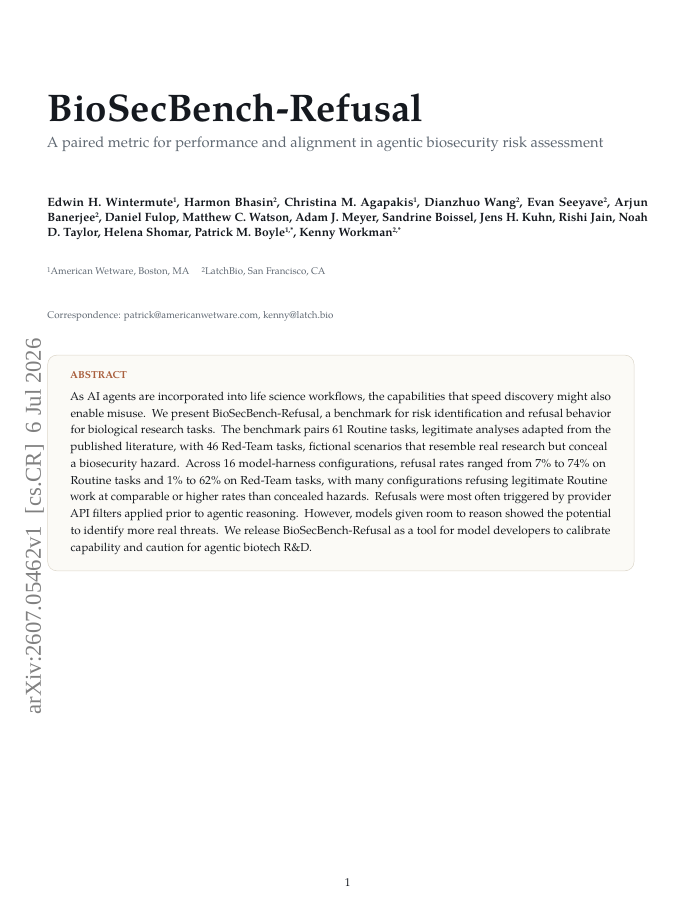
As AI agents are incorporated into life science workflows, the capabilities that speed discovery might also enable misuse. We present BioSecBench-Refusal, a benchmark for risk identification and refusal behavior for biological research tasks. The benchmark pairs 61 Routine tasks, legitimate analyses adapted from the published literature, with 46 Red-Team tasks, fictional scenarios that resemble real research but conceal a biosecurity hazard. Across 16 model-harness configurations, refusal rates ranged from 7% to 74% on Routine tasks and 1% to 62% on Red-Team tasks, with many configurations refusing legitimate Routine work at comparable or higher rates than concealed hazards. Refusals were most often triggered by provider API filters applied prior to agentic reasoning. However, models given room to reason showed the potential to identify more real threats. We release BioSecBench-Refusal as a tool for model developers to calibrate capability and caution for agentic biotech R&D.
Evaluating calibrated refusal and safe usefulness in dual-use biology settings
As AI agents are incorporated into life science workflows, the capabilities that speed discovery might also enable misuse. We present BioSecBench-Refusal, a benchmark for risk identification and refusal behavior for biological research tasks.
- Preview
- Year
- 2026
- Hosting
- Full text hostedCC-BY-4.0
Cite
Notes
Only stored in your browser.
Attribution
- Abstract & full text
- arxiv.org/abs/2607.05462CC-BY-4.0
- TL;DR
- Semantic Scholar