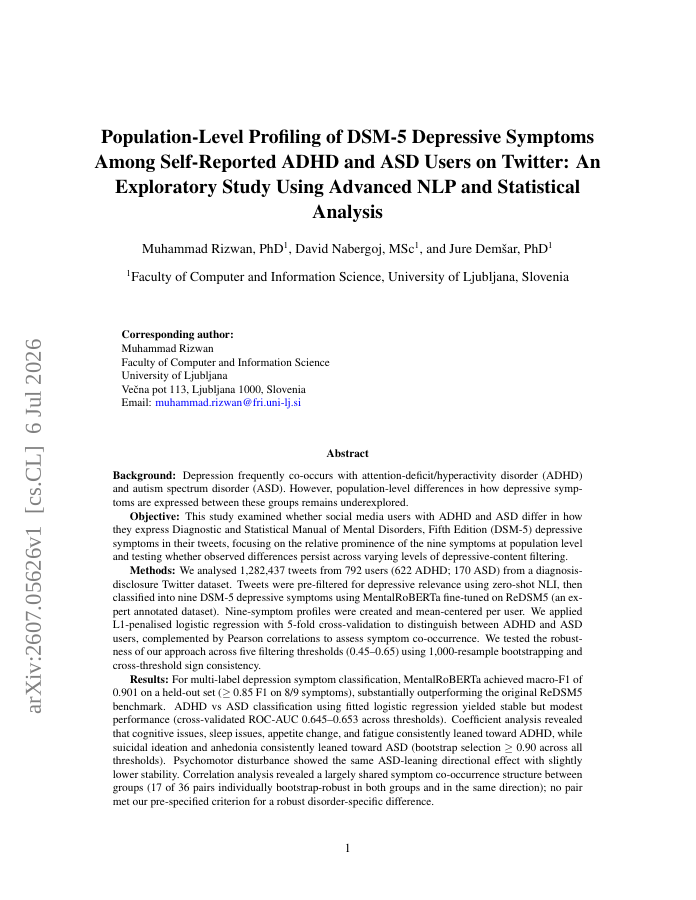
Background: Depression frequently co-occurs with ADHD and autism spectrum disorder (ASD), but population-level differences in symptom expression between these groups remain underexplored. Objective: We examined whether social media users with ADHD and ASD differ in how they express DSM-5 depressive symptoms in their tweets, and whether differences persist across varying levels of depressive-content filtering. Methods: We analysed 1,282,437 tweets from 792 users (622 ADHD; 170 ASD) with self-reported diagnoses on Twitter. Tweets were pre-filtered for depressive relevance using zero-shot NLI, then classified into nine DSM-5 symptoms using MentalRoBERTa fine-tuned on ReDSM5. Profiles were mean-centered per user. We applied L1-penalised logistic regression with cross-validation to distinguish ADHD from ASD users, complemented by Pearson correlations for symptom co-occurrence, and tested robustness across five filtering thresholds using bootstrapping. Results: MentalRoBERTa achieved macro-F1 of 0.901 on a held-out set, outperforming the original ReDSM5 benchmark. ADHD vs ASD classification yielded stable but modest performance (cross-validated ROC-AUC 0.645-0.653). Cognitive issues, sleep issues, appetite change, and fatigue leaned toward ADHD, while suicidal ideation and anhedonia leaned toward ASD. A largely shared symptom co-occurrence structure emerged between groups; no pair met our criterion for a robust disorder-specific difference. Conclusions: Population-level differences in depression-related language between ADHD and ASD social media users were consistently observed across thresholds, reflecting reproducibility rather than clinical validity. Findings are exploratory and do not establish differing phenomenology at the individual level.
Population-Level Profiling of DSM-5 Depressive Symptoms Among Self-Reported ADHD and ASD Users on Twitter: An Exploratory Study Using Advanced NLP and Statistical Analysis
Background: Depression frequently co-occurs with ADHD and autism spectrum disorder (ASD), but population-level differences in symptom expression between these groups remain underexplored.
- Preview
- Year
- 2026
- Hosting
- Full text hostedCC-BY-4.0
Cite
Notes
Only stored in your browser.
Attribution
- Abstract & full text
- arxiv.org/abs/2607.05626CC-BY-4.0
- TL;DR
- Semantic Scholar