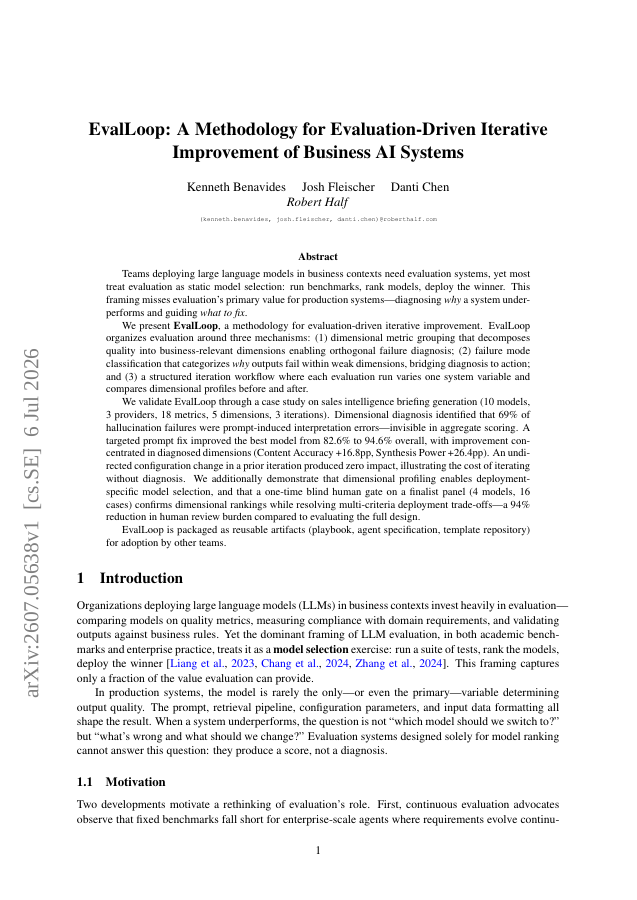
Teams deploying large language models in business contexts need evaluation systems, yet most treat evaluation as static model selection: run benchmarks, rank models, deploy the winner. This framing misses evaluation's primary value for production systems--diagnosing why a system underperforms and guiding what to fix. We present EvalLoop, a methodology for evaluation-driven iterative improvement. EvalLoop organizes evaluation around three mechanisms: (1) dimensional metric grouping that decomposes quality into business-relevant dimensions enabling orthogonal failure diagnosis; (2) failure mode classification that categorizes why outputs fail within weak dimensions, bridging diagnosis to action; and (3) a structured iteration workflow where each evaluation run varies one system variable and compares dimensional profiles before and after. We validate EvalLoop through a case study on sales intelligence briefing generation (10 models, 3 providers, 18 metrics, 5 dimensions, 3 iterations). Dimensional diagnosis identified that 69% of hallucination failures were prompt-induced interpretation errors--invisible in aggregate scoring. A targeted prompt fix improved the best model from 82.6% to 94.6% overall, with improvement concentrated in diagnosed dimensions (Content Accuracy +16.8pp, Synthesis Power +26.4pp). An undirected configuration change in a prior iteration produced zero impact, illustrating the cost of iterating without diagnosis. We additionally demonstrate that dimensional profiling enables deployment-specific model selection, and that a one-time blind human gate on a finalist panel (4 models, 16 cases) confirms dimensional rankings while resolving multi-criteria deployment trade-offs--a 94% reduction in review burden compared to evaluating the full design. EvalLoop is packaged as reusable artifacts (playbook, agent specification, template repository) for adoption by other teams.
EvalLoop: A Methodology for Evaluation-Driven Iterative Improvement of Business AI Systems
Teams deploying large language models in business contexts need evaluation systems, yet most treat evaluation as static model selection: run benchmarks, rank models, deploy the winner.
- Preview
- Year
- 2026
- Hosting
- Excerpt onlyCC-BY-NC-4.0
Cite
Notes
Only stored in your browser.
Attribution
- Abstract & full text
- arxiv.org/abs/2607.05638CC-BY-NC-4.0
- TL;DR
- Semantic Scholar