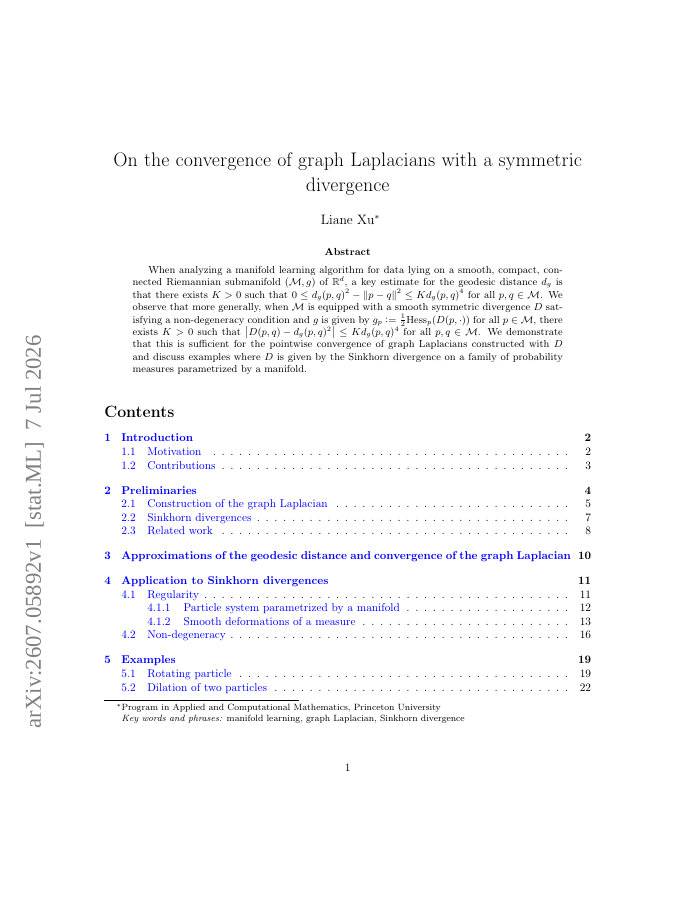
When analyzing a manifold learning algorithm for data lying on a smooth, compact, connected Riemannian submanifold (M, g) of \mathbb{R}^d, a key estimate for the geodesic distance d_g is that there exists K > 0 such that 0 \leq d_g(p, q)^2 - |p-q|^2 \leq K d_g(p, q)^4 for all p, q \in M. We observe that more generally, when M is equipped with a smooth symmetric divergence D satisfying a non-degeneracy condition and g is given by g_p := \frac{1}{2}Hess_p(D(p, \cdot)) for all p \in M, there exists K > 0 such that \left| D(p, q) - d_g(p, q)^2 \right| \leq K d_g(p, q)^4 for all p, q \in M. We demonstrate that this is sufficient for the pointwise convergence of graph Laplacians constructed with D and discuss examples where D is given by the Sinkhorn divergence on a family of probability measures parametrized by a manifold.
On the convergence of graph Laplacians with a symmetric divergence
When analyzing a manifold learning algorithm for data lying on a smooth, compact, connected Riemannian submanifold $(\mathcal{M}, g)$ of $\mathbb{R}^d$, a key estimate for the geodesic distance $d_g$ is that there exists $K > 0$ such that $0 \leq d_g(p, q)^2 - \|p-q\|^2 \leq K…
- Preview
- Year
- 2026
- Hosting
- Abstract onlyARXIV-DEFAULT
Cite
Notes
Only stored in your browser.
Attribution
- Abstract & full text
- arxiv.org/abs/2607.05892ARXIV-DEFAULT
- TL;DR
- Semantic Scholar