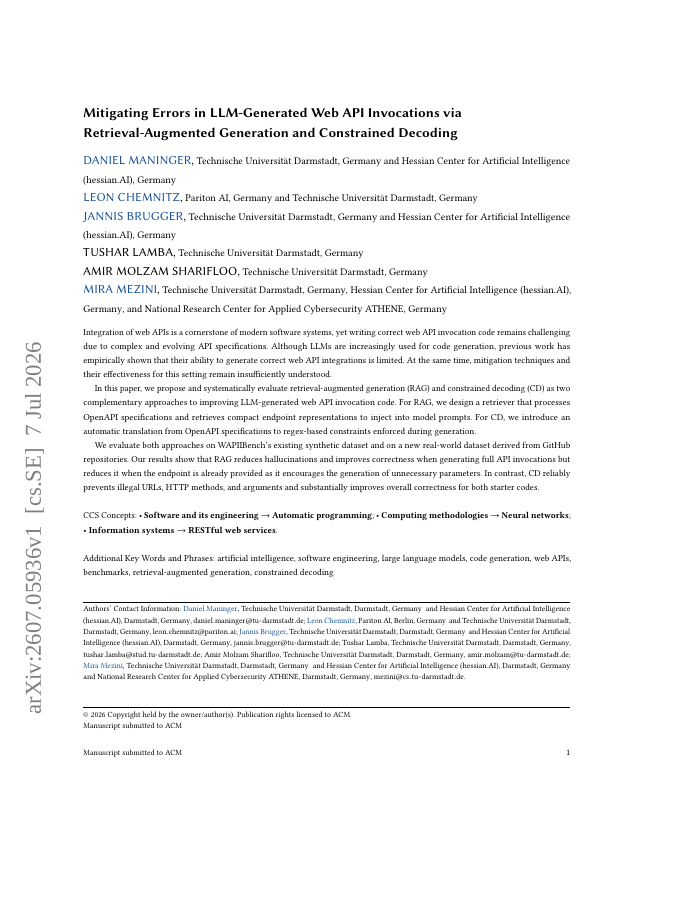
Integration of web APIs is a cornerstone of modern software systems, yet writing correct web API invocation code remains challenging due to complex and evolving API specifications. Although LLMs are increasingly used for code generation, previous work has empirically shown that their ability to generate correct web API integrations is limited. At the same time, mitigation techniques and their effectiveness for this setting remain insufficiently understood. In this paper, we propose and systematically evaluate retrieval-augmented generation (RAG) and constrained decoding (CD) as two complementary approaches to improving LLM-generated web API invocation code. For RAG, we design a retriever that processes OpenAPI specifications and retrieves compact endpoint representations to inject into model prompts. For CD, we introduce an automatic translation from OpenAPI specifications to regex-based constraints enforced during generation. We evaluate both approaches on WAPIIBench's existing synthetic dataset and on a new real-world dataset derived from GitHub repositories. Our results show that RAG reduces hallucinations and improves correctness when generating full API invocations but reduces it when the endpoint is already provided as it encourages the generation of unnecessary parameters. In contrast, CD reliably prevents illegal URLs, HTTP methods, and arguments and substantially improves overall correctness for both starter codes.
Mitigating Errors in LLM-Generated Web API Invocations via Retrieval-Augmented Generation and Constrained Decoding
Integration of web APIs is a cornerstone of modern software systems, yet writing correct web API invocation code remains challenging due to complex and evolving API specifications.
- Preview
- Year
- 2026
- Hosting
- Full text hostedCC-BY-4.0
Cite
Notes
Only stored in your browser.
Attribution
- Abstract & full text
- arxiv.org/abs/2607.05936CC-BY-4.0
- TL;DR
- Semantic Scholar